Truman Show - Gnostic perspective
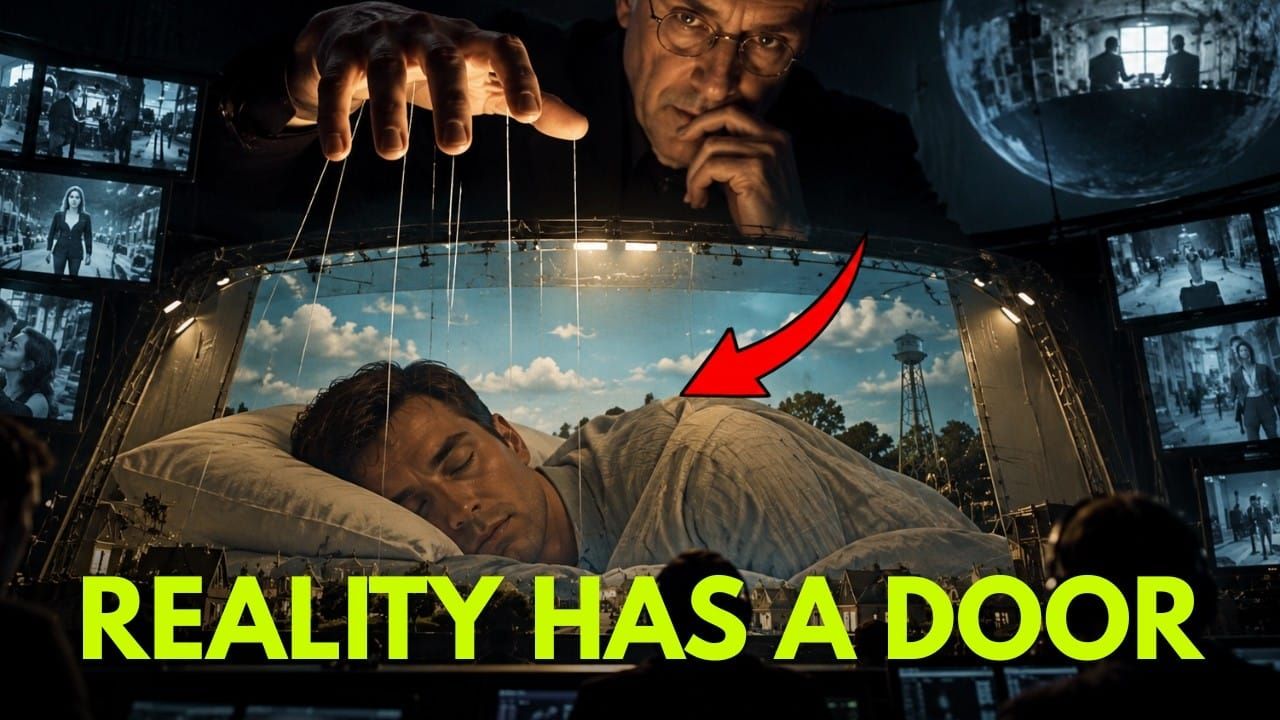
The video argues that The Truman Show (1998) is not merely a satire of reality television, but an almost point-for-point retelling of Gnostic cosmology — a second-century religious system whose writings were mostly destroyed and only recovered in the 20th century, buried in the Egyptian desert. The presenter explicitly flags where he is making a strong case and where he may be reaching, and addresses the main counterargument head-on.
The Central Parallel: Truman's World and the Gnostic Cosmos
- Truman's situation: born into a constructed world (the Seahaven dome) where everyone he meets is an actor, every event is arranged, and his creator-director Christof watches from a control room inside an artificial moon, controlling the sun, weather and tides.
- The Gnostic claim: the world we inhabit is a fabrication built by the demiurge ("craftsman") — not the true God — a copy so convincing that almost no one ever suspects it is a construction.
- The crucial match: the demiurge is not a simple villain. He believes he is doing good, that his world is the only and best world, and that keeping conscious beings inside it is an act of care — "a jailer who loves his prisoner and calls the prison a home." That, the presenter argues, is Christof exactly: when Christof's voice finally booms from the sky, he insists the real world is sick and dangerous, while inside Seahaven "there is nothing to fear." He is not lying — he believes it — and that is what makes him the demiurge rather than merely a bad man.
Key Points
1. The name "Truman" as the Gnostic spark
- The Gnostics held that inside the false world are beings carrying a fragment of the true source — a spark of the real trapped in the fabrication, surrounded by scenery, actors and arranged events.
- "Truman" ("true man") is that idea compressed into one word: the one authentic thing in a world of performances.
- The presenter is honest that screenwriter Andrew Niccol may not have intended this ("maybe the name just meant an honest everyman"), but argues intent is irrelevant: when you tell the truest version of a person trapped in a fake world, you end up telling the Gnostic story, because it is the deepest version humans have found.
2. The mechanism of awakening (gnosis)
- Truman does not wake up because someone shows him the blueprints — consistent with the Gnostic teaching that gnosis (awakening knowledge) cannot be handed over as information; it must be recognised from the inside.
- Awakening happens through anomalies — cracks in the false world's surface:
- a stage light (labelled with a star's name) falling from the sky;
- a crossed radio frequency revealing the crew narrating his movements;
- an elevator with no interior;
- his "dead" father reappearing as a homeless man before being hustled away.
- None is proof on its own; Truman explains them away for years, just as we all do. Awakening is not one revelation but the slow accumulation of moments that do not fit until the false picture cracks at once. Truman's heroism is simply "the refusal to keep looking away."
3. The counterargument — and the response
- Objection: "hero discovers his world is false" is one of the most common story shapes (Plato's cave, countless myths and films); the resemblance may prove nothing.
- Response: the objection would hold if the parallel were only generic, but the specifics align:
- a single maker figure who is not evil and believes imprisonment is love (rare — most false-world stories have a cruel oppressor or cold machine);
- a hero who is the sole authentic being among performances;
- escape achieved through chosen attention to accumulating anomalies, not a single revelation.
- Generic stories share generic features; when three or four specific, unusual features all line up, the objection weakens.
4. The ending as Gnostic scripture
- Christof, when comfort fails, turns to force — conjuring a storm to keep Truman in: "a demiurge who cannot keep you asleep with comfort will try to keep you asleep with terror," echoing the Gnostic claim that the rulers of the false world use fear as their final tool.
- Truman lashes himself to the mast and defies him; the bow of the boat strikes the painted sky — the horizon revealed as a wall a few inches thick with nothing behind it but machinery.
- Truman finds a staircase and a door set into the edge of the sky, painted the colour of the false heaven so it would never be noticed. At the threshold, Christof's voice returns — no longer threatening but pleading: the outside holds only pain and uncertainty; in here he is safe, known, loved.
- The Gnostics identified this as the hardest moment — harder than seeing the walls — because the jailer returns to love, "and love is so much harder to walk away from than fear."
- Truman delivers his catchphrase greeting as farewell and declaration of independence, bows, and steps into the dark. The film cuts to black and refuses to show the other side — as the Gnostics could not show it either. They could only say there was a door, painted to look like the sky.
Three Points the Presenter Returns To
- The installed fear of water — the production staged his father's drowning to give Truman a lifelong terror of the sea, the one direction in which escape is possible. The boundary is guarded not by a wall but by his own fear: the most effective prison is one whose walls are installed inside you, experienced as your own personality. His liberation is precisely sailing through his deepest programmed terror; the storm is that installed fear made external and final.
- The audience — viewers know Truman's world is false yet are just as captured, consuming a fabricated life because they have lost contact with the real one. The Gnostics had a category for those who half know the world is a construction and are entertained by it anyway. The film's darkest judgement lands at the very end: two devoted watchers respond to Truman's escape by saying, "Let's see what else is on." "That is the Gnostic tragedy stated as a punchline — aimed directly at the person watching the movie."
- The nature of Christof's love — he is not a sadist; he genuinely loves Truman and believes Seahaven is a gift, mirroring the demiurge who is not evil but ignorant: he cannot conceive anything better than what he has made. The film is honest enough to leave open the terrible question of whether, in a limited sense, he might be right — the real world does contain genuine pain Seahaven does not. The film sides with Truman (terror and freedom over safety and captivity), but recognises that "a prison guarded by love is far harder to leave than a prison guarded by cruelty" — the demiurge's most powerful hold being not tyranny but kindness.
Closing Argument
The Gnostics told the story not as entertainment but as diagnosis: you are Truman before the storm — not with literal cameras, but handed a version of reality, a set of assumptions about what is possible and where the edges are, maintained partly by others and partly by your own willingness to look away. The construction around you is maintained "by your own willingness to explain the anomalies… and never sail toward the edge." Neither the filmmaker nor the ancient writers could describe the outside; the only thing that can be done for a sleeping person is to convince them "against every comfort and every fear" that the sky is only a few inches thick. As the presenter puts it:
"The wall has always had a door. The maker has always been pleading with you to stay. And the only thing that has ever separated the sleepers from the ones who walk out is the willingness to sail all the way to the edge of the world and put your hand against the sky."