UK breakup and Germany
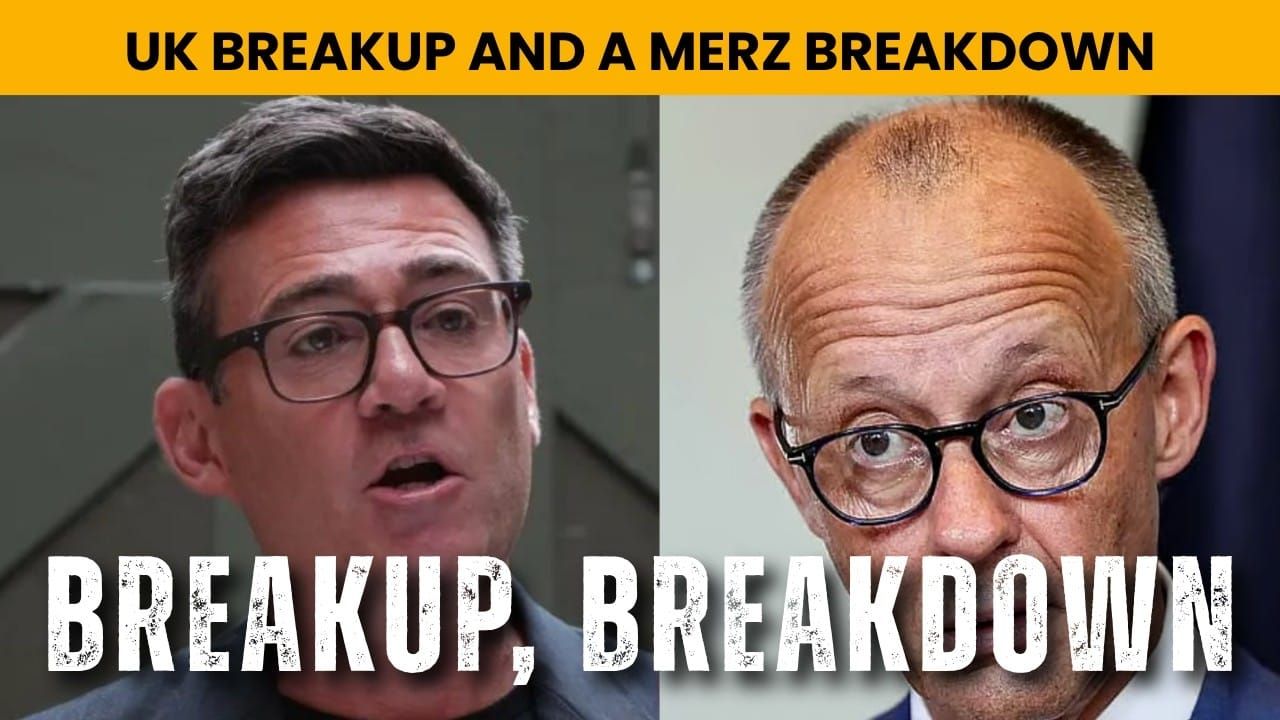
A two-speaker discussion (interviewer and "Alexander") covering a declaration by the UK's devolved First Ministers and German politics.
Part 1: The First Ministers' independence declaration
A meeting took place in Wales between the First Ministers of Scotland, Wales and Northern Ireland, who signed a declaration calling for their nations to leave the United Kingdom.
How serious is it?
- Alexander's verdict: at this stage it is "mostly a media PR stunt".
- All three nations have nationalist governments:
- Scotland — the SNP
- Wales — Plaid Cymru
- Northern Ireland — Sinn Féin
- He does not expect an immediate move; London (and Andy Burnham, despite dithering) will oppose it, and nothing will happen this year or next. But with the UK economy declining and English nationalism rising in England itself, the issue is now "on the time horizon" — in a year or two his answer could differ.
Northern Ireland
- He is confident it will join the Republic of Ireland "relatively soon".
- Its remaining in the UK after Irish independence in 1922 (following a bitter independence war) was "always something of an anomaly" — rooted in Britain's obligation to the Protestant population and control of key military industries and shipyards, factors that diminish every year.
- He believes people in England will take it in their stride.
Wales
- Furthest from independence: joined the English crown in the 14th century, and many in Wales would oppose outright secession — though sentiment is shifting.
- The Brexit complication: Scotland voted Remain in 2016, but Wales voted Leave — some areas by overwhelming margins. So the declaration's intention to leave the UK and join the EU (immediately surrendering sovereignty to "Ursula in Brussels", as the interviewer put it) is "an almost impossible sale" in Wales.
- Plaid Cymru has always been pro-EU — historically a liability. It won recent elections largely because of huge anger at the Labour Party, which historically dominated Welsh politics (Keir Starmer was still Prime Minister at the time).
- If offered independence, London or Brussels, support for independence would far exceed support for joining the EU.
Scotland
- A gradual shift towards independence over 20 years, but Scottish politics are complicated: the SNP is not especially popular, surviving mainly because Labour and the Conservatives are even more unpopular.
- Anti-EU sentiment (and Reform) is growing there, though pro-EU sentiment is probably still stronger.
- Scottish secession in the next few years is more imaginable than Welsh secession — and if it happens, there could be an interesting debate about whether Scotland joins the EU or follows Norway and Iceland. Given Scotland's close historic ties with Norway, the three could form an interesting group outside the EU — and "they would definitely be better off".
Part 2: Germany — the CDU collapse
- New polling for Mecklenburg-Vorpommern (the state in north-eastern Germany on the Baltic, with elections coming) puts the CDU at just 7%; some claim it could fall below the 5% threshold and miss seats in the state parliament — which would be "stunning, almost unthinkable" for the core party of the Federal Republic.
- The chancellor has come across as very angry and difficult since the Saxony-Anhalt result, refusing to shift his policies "by 1 cm" despite being probably the most unpopular chancellor in German history, further alienating a CDU that was never fully enthusiastic about him.
- If Mecklenburg-Vorpommern's results are as bad as expected, he could be gone "within the next few weeks". Although removing a chancellor in Germany is theoretically complicated, politics has a way of making complicated things simple when the imperative arrives.