Unfiltered discussion
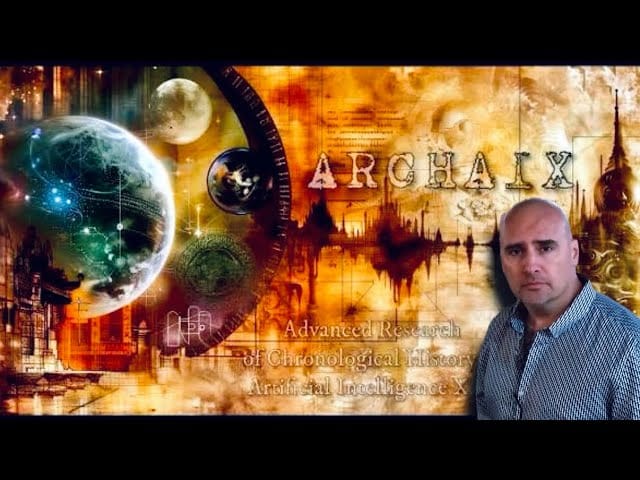
In this extensive dialogue, Heidi Luv hosts Jason Breshears, known for his channel Archaix, to discuss a wide range of topics including simulation theory, ancient history, Mormonism, intelligence apparatuses, and the nature of reality itself. Jason, an ex-convict who turned to publishing and research during a long prison sentence, brings a unique perspective based on deep historical analysis and "pattern recognition" rather than theoretical models. He argues that history is a mathematical construct designed to prove humanity lives in a simulation.

Simulation Theory and Artificial Reality
Jason opens by explaining that his research focus is Archaix, which seeks to demonstrate through historical records that theoretical physicists are correct about the simulation hypothesis. He posits that we do not live in a "real reality" but in a "perceived reality." He claims to have found definitive mathematical patterns in history—including resets, looping constructs, and palindromic sequences—that cannot be coincidental. His goal is to show that the historical record itself proves we are in an AI-controlled simulation. He contrasts his approach with others who rely on predictive analytics or deep learning models, asserting that value comes from verifying these patterns through documented history.
The Nature of Religion and Jesus
A significant portion of the discussion revolves around religion. While Heidi identifies as a Christian, Jason describes himself as having "researched himself out of Christianity" despite a Puritanical upbringing. He clarifies that he has great respect for the teachings of Jesus, particularly the parables and the "Golden Rule," but he rejects the later theological additions. He argues that the concepts of Jesus dying, bleeding, and physically ascending were added by the church centuries later. He views Jesus as a master teacher who understood that we live in the "photo negative" of a real reality and that one must acknowledge a lie to alchemise it into truth (faith). He concludes that the spiritual teachings are paramount, while the miracles and mythological attachments are irrelevant to the core spiritual message.
The Doctrine of Substitution and Ancient Babylon
The conversation takes a darker turn as Jason introduces the "Doctrine of Substitution." He traces this back to ancient Babylon and Egypt, specifically regarding a group called the Typhonians—ginger-haired people (likely Hyksos) who were hated and sacrificed by the Egyptians. Jason explains that originally, animal sacrifice was the norm, but over time, this doctrine allowed the substitution of animals for humans and eventually humans for animals in reverse. He suggests that the ancient Babylonian temples were actually intelligence agencies. He describes a system where men would bring gifts (money, goods, or even secrets/intel) to the temple in exchange for carnal relations with "vestal virgins." These temples acted as hubs for information gathering, similar to modern intelligence agencies, under the guise of religious sacral prostitution.
This doctrine, Jason argues, is the root of the concept of the scapegoat. He contends that the Jewish term "goyim" originally referred to cattle—non-Jews who could be used as scapegoats to transfer guilt. This creates a framework where one group can victimize another under religious sanction, a concept he believes permeates history into the modern era, including practices involving elites.
Mormonism as an Intelligence Apparatus
Heidi, who has a background in the LDS church, brings the discussion to Mormonism. She expresses her dismay upon discovering the Masonic and occult roots of the temple ceremonies, such as the "Typhonian Y" hand gesture during prayer, the washing and anointing rituals, and the passing through veils—all of which mimic the Babylonian temple practices Jason described earlier. Jason admits he hadn't focused on Mormonism prior to their conversation but quickly finds it fascinating.
The two discuss the possibility that the Mormon church functions as an intelligence apparatus. They note that early Mormons, such as Joseph Smith, were connected to powerful families and networks. Heidi highlights connections between Smith's ancestors, the Seixas family (who were involved with George Washington and the first Thanksgiving), and the founding of American banking. They discuss the Zionist Brotherhood in Ephrata, Pennsylvania, a group that pre-dated Joseph Smith but practised identical temple rituals, including baptisms for the dead in white clothing. Jason suggests this indicates a coordinated infiltration or "plan from the beginning" rather than a spontaneous religious movement.
Heidi lists numerous surprising historical overlaps:
- Orson Hyde, a Mormon Jew, dedicates land in Israel to the LDS church before the Balfour Declaration.
- Joseph Smith’s grandfather testified at the Salem witch trials, and the Giles family involved in the trials married into the Smith family for six generations.
- Joseph Smith claimed to be of the bloodline of Jesus and Mary Magdalene.
- A splinter group led by a "James String" (likely James Strang) started the "Houselon Illuminati," using the "Book of the Law of the Lord" instead of the Book of Mormon.
They also discuss how the CIA and intelligence agencies seem to use Mormon "assets," pointing to figures like Erica Marsh (associated with Charlie Kirk) and her family connections to Utah and intelligence training. Jason notes that the LDS church has early missions to Russia and England, integrating with banking families like the Rothschilds and railroad magnates, creating a powerful network.
Media Manipulation and the "Hidden Hand"
The dialogue touches on recent events, such as the Epstein files and the media's role in information overload. Jason suggests that when massive amounts of information are "dumped" on the public simultaneously, it is a tactic to hide a specific, crucial event that is "slipping through the cracks." They discuss the concept of honeypots, not just in ancient temples but in modern high-end nightclubs where young women are recruited, and their backgrounds checked to see if they are "disposable." Both hosts agree that the elites use infiltration and co-option rather than destruction; they "get behind enemy lines" and use their enemies without their knowledge.
Historical Anomalies: Howard Hughes and St. Germain
Heidi shares her research into Howard Hughes, noting his connections to the "Mormon Mafia." She explains that Mormons managed Hughes' business and medical institutes after his death. She speculates that Hughes might have been a "time traveller," citing old books that mention him in historical contexts long before his life. She also connects him to secret government drilling projects (like those near the Azores) and the CIA, suggesting he was retrieving something, possibly a submarine, but perhaps something more significant like ancient technology.
Jason brings up the historical figure St. Germain (the Comte de St. Germain), a man seen at European courts for 117 years without ageing. He spoke multiple languages fluently and possessed a mastery of history that astounded nobility. Jason shares stories of people who met him when they were young and then again decades later, shocked that he hadn't aged. He uses this anamoly to illustrate that there are things in this world, like time travel or advanced life extension, that defy our current understanding.
The Nature of the Enemy and Benefactors
Towards the end, the conversation turns philosophical. Jason ponders why the elites need so much subterfuge and secrecy. If they are all-powerful, why not simply dominate openly? He deduces that there must be an opposing force, or "benefactors," that constrain them. He theorizes that the elites might be bifurcated into opposing groups (Luciferians vs. others), resulting in a media war where neither side has humanity's best interest at heart, but the conflict itself allows for some freedom.
Despite the grim outlook on the world—which Jason describes as a "predator vs. prey" construct essentially hellish in nature—they end on a hopeful note. Jason argues that the very fact that they can have this conversation openly suggests that there is a benefactor force protecting them. He advises listeners to rely on intuition, which he defines as the bridge between the individual and the "oversoul." Heidi echoes this sentiment, emphasizing the importance of the Golden Rule and maintaining hope, which she believes the "enemy" fundamentally cannot defeat.
Conclusion
Ultimately, the discussion weaves a complex tapestry connecting ancient Babylonian rituals to modern New World Order conspiracies, suggesting that many powerful organizations, including religious institutions like the Mormon church, are fronts for intelligence gatherers and occultists. They conclude that while the world is likely a simulation or a controlled prison for the "oversoul," individuals should focus on their own spirituality, intuition, and ethical treatment of others to navigate the experience.