Upside down cosmos
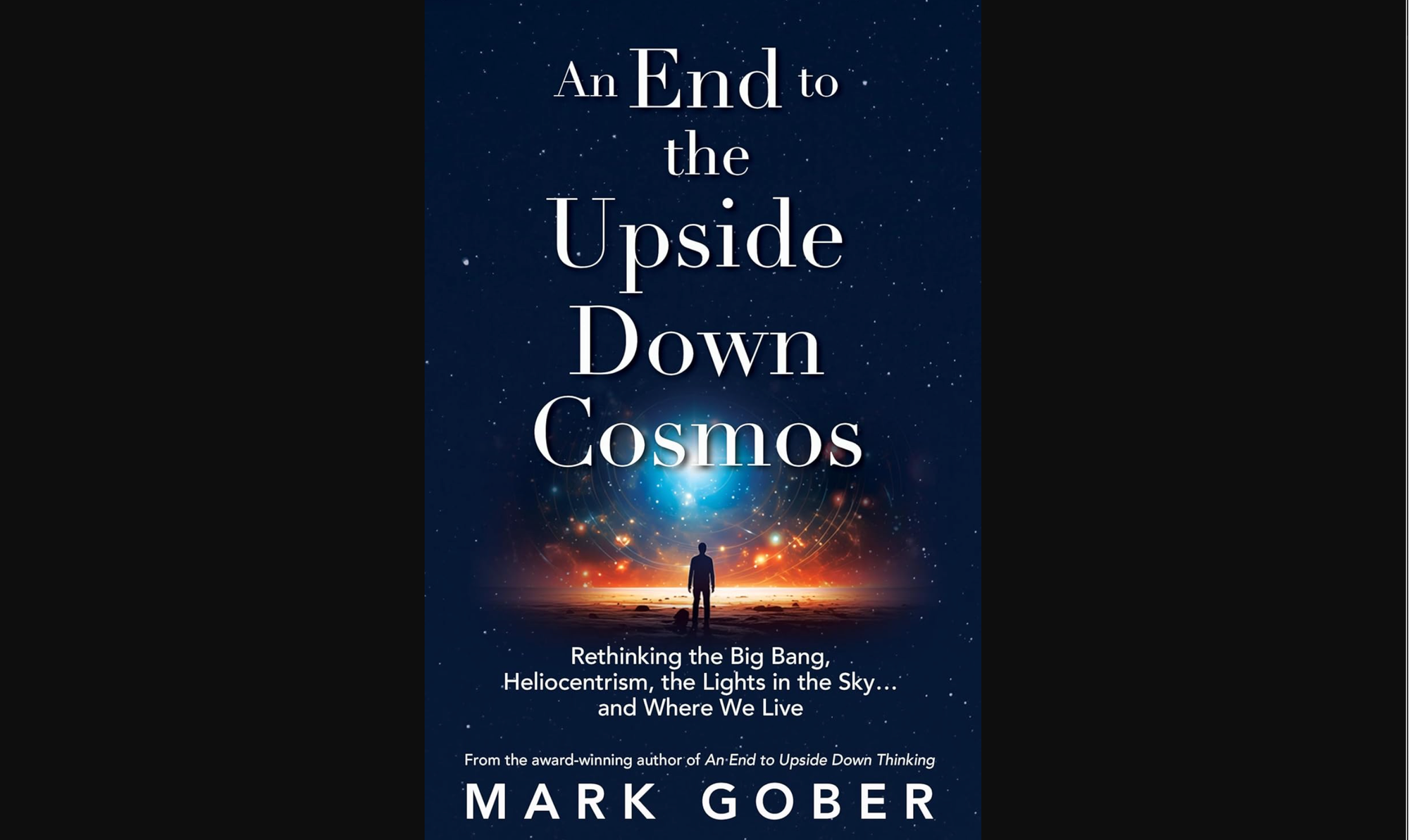
In this book, Mark Gober questions the foundational pillars of modern cosmology—specifically the Big Bang, heliocentrism, and the globe model of the Earth—arguing that the mainstream scientific consensus is the ultimate "upside-down" deception designed to make humanity feel insignificant.
Here is the detailed summary of the book, broken down into its three parts and key chapters:
Part 1: The Mainstream Cosmological Narrative
In the first part of the book, Gober examines the current accepted model of the universe and highlights the massive, often ignored scientific anomalies and assumptions required to keep it intact.
Key Chapters and Concepts
- The Copernican Principle: Gober explores how humanity was decentered. He explains how science shifted from believing Earth was the special, stationary center of creation to just a random speck of dust in an infinite, godless vacuum.
- The Big Bang and Theoretical Physics: He critiques the reliance on theoretical mathematics over empirical observation. He discusses how "Dark Matter" and "Dark Energy" are essentially placeholders invented by astrophysicists because their gravitational equations do not work when applied to the observable universe.
- The Illusion of Space Exploration: Gober introduces skepticism regarding the claims of global space agencies (like NASA), questioning the validity of the Apollo moon landings, the International Space Station (ISS) footage, and the reliance on CGI (computer-generated imagery) and composite images to depict the Earth from space.
Part 2: The Evidence Against the Standard Model
This is the most controversial section of the book. Gober systematically presents the empirical, physical, and historical evidence that contradicts the spinning globe model, arguing for a stationary and potentially enclosed or flat Earth.
Key Chapters and Concepts
- The Missing Curvature: Gober looks at physical tests over long bodies of water (like lasers, mirrors, and long-distance photography) that consistently fail to detect the mathematical curvature required by a globe with a circumference of 24,901 miles.
- The Motionless Earth: He details historical scientific experiments designed to measure the rotation and orbit of the Earth—such as the Michelson-Morley experiment and Airy's Failure. Gober argues these experiments actually proved the Earth is stationary, but mainstream science invented Special Relativity to explain the results away.
- Alternative Physics (Gravity vs. Density): Gober questions Newtonian gravity. Instead of gravity pulling masses toward a core, he explores how buoyancy, density, and electromagnetism provide a more functional explanation for why objects fall and how the physical world operates.
- The Firmament and the Enclosed Cosmology: Examining ancient cosmologies, Gober investigates the concept that:
the Earth is a contained, localized system (often depicted with a dome or firmament) rather than an open planet floating in a vacuum.
Part 3: The Meaning of the Cosmos (Implications)
In the final section, Gober ties this alternative cosmology back to his overarching thesis: consciousness. He explores why such a massive deception would exist and what an Earth-centric cosmology means for human spirituality.
Key Chapters and Concepts
- The Origins of Nihilism: He argues that the heliocentric, Big Bang model is inherently nihilistic. If we are an accident in an endless void, life has no intrinsic meaning. The "upside-down" cosmos is designed to disconnect humans from their divine nature.
- A Designed Realm: If the Earth is a stationary, enclosed, and specially created environment, it necessitates a Creator or an Architect. This shifts the universe from an accidental explosion into a purposeful "terrarium" designed specifically for conscious experience.
- Tying it all Together: Gober integrates this cosmology with his previous work on NDEs, telepathy, and non-human entities. In a closed system, "aliens" are not extraterrestrial beings traveling lightyears from other planets, but rather interdimensional entities or localized phenomena interacting with our specific spiritual training ground.
Here is a visual representation of the cosmological shift Gober proposes in the book:

Compared to the Standard "Official" model:

| Concept | The Mainstream Cosmology | Gober's Right-Side-Up Cosmology |
|---|---|---|
| Origin | Random, accidental Big Bang | Purposeful, conscious creation |
| Earth's Nature | A spinning sphere in an infinite vacuum | A stationary, likely enclosed, localized plane |
| Physics | Theoretical math, gravity, dark matter | Empirical observation, density, electromagnetism |
| Philosophical Result | Materialism, atheism, nihilism | Spiritual significance, connection to the Creator |