Upside down Everything
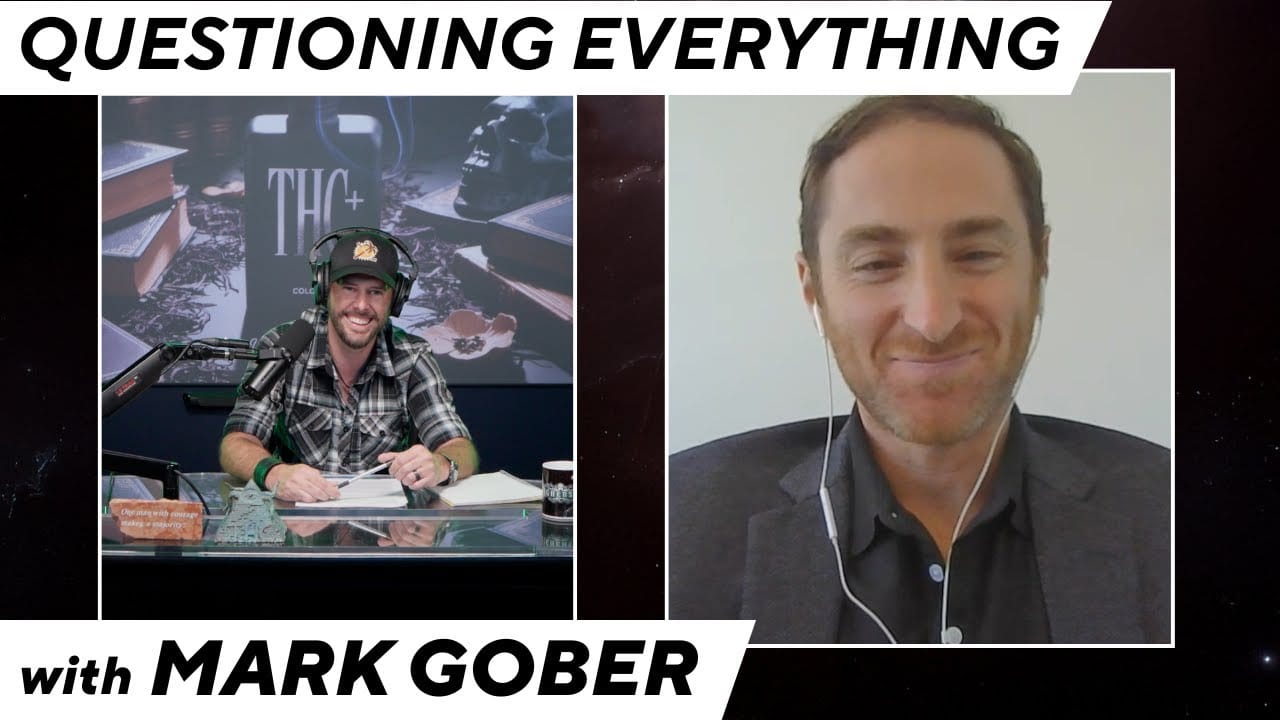
Mark Gober joined Greg to discuss his book An End to Upside Down Thinking, which challenges materialist assumptions about consciousness, reality, and human capabilities. The interview covered near-death experiences, psychic phenomena, the nature of consciousness, and implications for how we understand human existence.
Core Thesis: Consciousness Beyond the Brain
Gober's central argument, developed through extensive research, is that consciousness is not produced by the brain but rather exists independently of it. He describes this as "filter theory" or "transmission theory"—the brain acts as a receiver or filter for consciousness rather than its generator. This framework, he explains, better accounts for anomalous phenomena that materialist science struggles to explain.
Gober cites the work of physicist Sir James Jeans, who stated: "The universe begins to look more like a great thought than like a great machine." This encapsulates the idealist philosophical position Gober advocates—where consciousness is fundamental to reality rather than an emergent property of matter.
Near-Death Experiences (NDEs)
A significant portion of the interview addressed NDEs, which Gober presents as powerful evidence for consciousness surviving bodily death. He highlights several key findings:
- Veridical NDEs: Cases where individuals report accurate perceptions during cardiac arrest when brain activity is absent. Gober references the AWARE study (AWAreness during REsuscitation) led by Dr. Sam Parnia, published in Resuscitation (2014). This study documented a case where a patient accurately described resuscitation procedures occurring during a three-minute period when their heart had stopped and brain activity was absent.
- Timing accuracy: NDE experiencers often report events occurring with verified timestamps, demonstrating perception when the brain is non-functional.
- Psychological transformation: Gober notes the profound after-effects documented by researchers including:
- Loss of fear of death
- Increased sense of purpose
- Enhanced intuition and psychic sensitivity
- Reduced materialism and increased altruism
Gober specifically cites the work of Dr. Bruce Greyson and his NDE scale, as well as the longitudinal studies by Dr. Kenneth Ring and Dr. Jeffrey Long, whose database at the Near Death Experience Research Foundation contains over 4,000 cases.
Psychic Phenomena and Extended Human Capabilities
Gober discusses multiple categories of psychic phenomena supported by scientific research:
Remote Viewing
- The Stargate program: Declassified CIA documents reveal decades of government-funded research into psychic perception at Stanford Research Institute (SRI) and later Science Applications International Corporation (SAIC).
- Gober cites physicists Hal Puthoff and Russell Targ's work, noting that remote viewing demonstrated statistically significant results above chance.
- Specific operational successes: The location of a downed Soviet bomber in Africa (1979) and intelligence gathering during the Iranian hostage crisis.
Precognition
- Gober references Daryl Bem's controversial 2011 paper "Feeling the Future" in the Journal of Personality and Social Psychology, which reported nine experiments demonstrating retrocausal effects.
- The "presentiment" research of Dr. Dean Radin at the Institute of Noetic Sciences, showing physiological responses before random future events occur.
Telepathy
- The Ganzfeld experiments, analyzed by parapsychologist Daryl Bem and others, showing replicated effects with combined probability against chance of less than one in a billion.
- Research on dream telepathy at the Maimonides Medical Center by Dr. Stanley Krippner.
Gober emphasizes that these phenomena have been replicated across multiple laboratories and meta-analyses, including:
- The 1985 U.S. Army report by the National Research Council acknowledging remote viewing's validity
- The 1995 CIA-sponsored American Institutes for Research review, which while publicly skeptical, acknowledged statistically significant effects
Reincarnation Research
Gober discusses the work of Dr. Ian Stevenson and his successor Dr. Jim Tucker at the University of Virginia Division of Perceptual Studies:
- Methodology: Systematic investigation of children's spontaneous past-life memories, with documentation of specific details verifiable against deceased individuals' lives.
- Strength of evidence: Cases with:
- Birthmarks corresponding to wounds on the deceased
- Knowledge of private information unknown to the family
- Behavioral patterns matching the purported previous personality
- Recognition of previous-life relatives and friends
- Scale of research: Over 2,500 cases investigated, with many published in peer-reviewed journals including the Journal of Scientific Exploration and Journal of Nervous and Mental Disease.
Gober cites specific cases including:
- The case of James Leininger, an American child who recalled being a WWII pilot shot down at Iwo Jima, with verified details including the pilot's name (James Huston), aircraft carrier, and circumstances of death.
- Cases from India, Thailand, and Myanmar (Burma) where children spoke languages they had not learned and identified previous-life locations.
The Hard Problem of Consciousness
Gober engages with philosopher David Chalmers' formulation of the "hard problem"—why and how physical processes give rise to subjective experience. He argues:
- Materialist explanations (integrated information theory, global workspace theory) describe correlations but don't explain the emergence of qualia.
- The "explanatory gap" remains unbridged after decades of neuroscience.
- Idealist frameworks where consciousness is fundamental avoid this problem entirely.
He cites philosopher Thomas Nagel's famous paper "What Is It Like to Be a Bat?" and the continued absence of any materialist solution to the problem Nagel identified in 1974.
Surprising and Significant Points
The interview contained several striking revelations:
- Government documentation extent: The declassified Stargate program files exceed 89,000 pages, indicating far more extensive official investigation than commonly acknowledged.
- Mainstream scientific acknowledgment: Gober notes that the American Psychological Association's 2014 Handbook of Psychology included a chapter on parapsychology by Etzel Cardeña, legitimizing the field.
- Physics convergence: Quantum mechanics findings increasingly align with consciousness-centric interpretations:
- The measurement problem and observer effects
- Non-locality and entanglement
- John von Neumann's analysis placing the "cut" between observer and observed as fundamentally arbitrary
- Medical professional experiences: Surveys indicate 10-20% of physicians have witnessed apparently inexplicable healings or knowledge in patients.
- Cross-cultural consistency: NDE features remain remarkably consistent across cultures and belief systems, suggesting genuine experiential rather than cultural origin.
- Children's spontaneous cases: Young children often express past-life memories between ages 2-4, before cultural conditioning, and typically forget them by age 7-8—a specific developmental window.
Practical Implications
Gober concludes with transformative implications of accepting this evidence:
- Death anxiety reduction: Understanding consciousness survives physical death fundamentally alters one's relationship with mortality.
- Expanded identity: Recognition of consciousness beyond the individual ego fosters connection and compassion.
- Human potential: Acknowledging extended capacities opens possibilities for intentional development of intuition, healing, and creative insight.
- Scientific reform: The need for expanded scientific methodology that doesn't a priori exclude subjective and anomalous data.
The interview represents a comprehensive synthesis of decades of para-psychological and consciousness research, presented as challenging the materialist paradigm that Gober argues has dominated science to its detriment.