USA Endgame
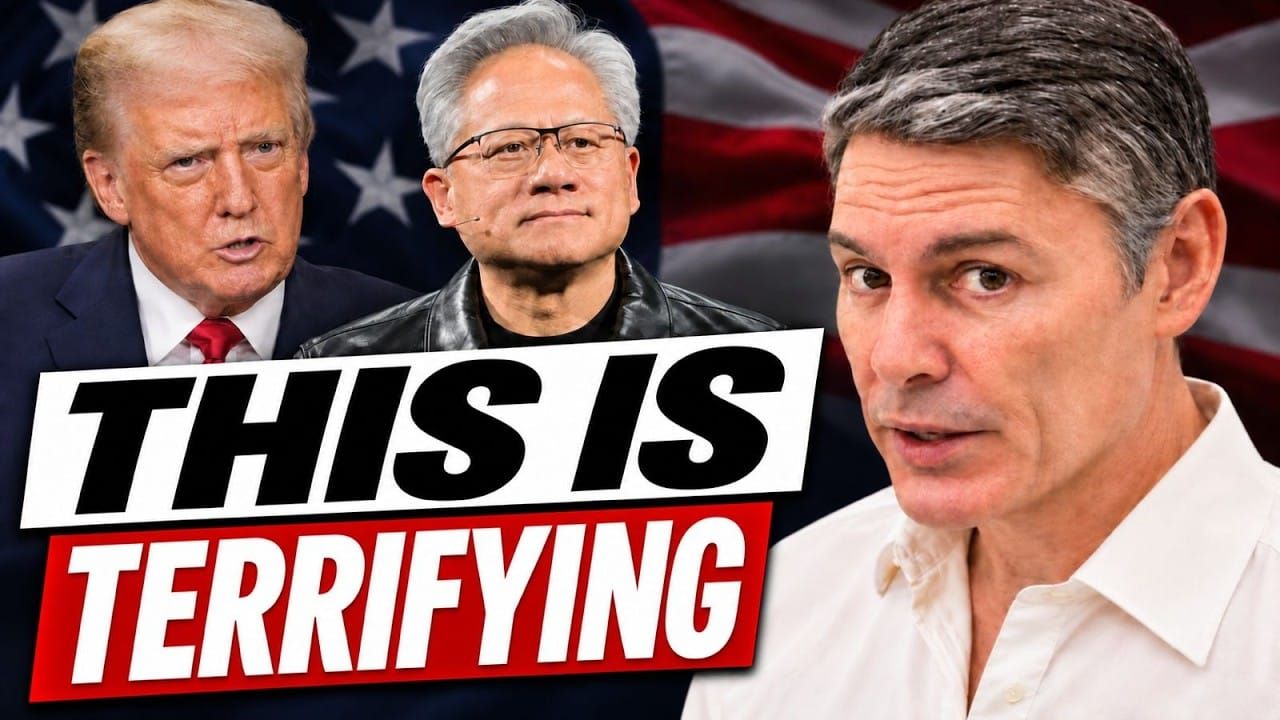
Step 1 — "WTF just happened"
George Gammon's core argument: the board's "emphatic" refusal on 17 November and its reversal five days later cannot be explained by new evidence, because no agency could have discovered anything material over a weekend that it did not already have. The only genuine variable that changed was that the market crashed on the Thursday and Friday. Therefore, in his words, the presidency has shifted "from protecting the Constitution to actually protecting the stock market."
Timeline as given in the video
| Date (2026) | Event |
|---|---|
| 29 Oct | Accusations surface: an affair with a woman suspected of Chinese intelligence links, plus alleged illegal GPU sales to China via a Singapore shell corporation |
| 8 Nov | Huang admits an affair; board announces a "full-on" investigation |
| 12 Nov | Huang resigns; the CFO takes over temporarily |
| 17 Nov | Board publicly states it will not rehire Huang |
| 20 Nov | SEC opens an investigation into Nvidia's accounting practices ("think Enron") |
| 21–22 Nov | Trump administration signals Huang is "clean"; board reverses |
| ~23 Nov | Huang reinstated; Trump takes credit |
He concedes the point people will raise — that Trump "merely made a suggestion" — and then attacks it via a Wall Street Journal piece titled (as read out) "Then and Now: See How Nvidia and the Administration Pivoted on Jensen".
Step 2 — The wider pattern: "state capitalism" as corporatism
George's stated position: this is not about whether Huang should be CEO. He grants Huang delivered enormous shareholder value and says the affair itself is beside the point — the real issues were the China/Singapore export allegations and the cursory investigation.
The principle he invokes: even if you like this intervention, the power does not stay with the person you like. "Sooner or later it ain't going to be Donald Trump that's doing it. It's going to be Mamdani. It's going to be AOC" — at which point the same cheerleaders will call it socialism. He likens presidential pressure on boards to a Chicago mob boss of the 1920s.
Treasury Secretary Scott Bessent is the primary target. The video plays his 15 November Fox News remarks that the board should "go outside the company" for a new leader and that, had Nvidia been a bank, regulators would have removed executives. It then plays a later clip in which Bessent answers a question about the national-security risk with "Well, Jensen is on the outside now" — which the presenter calls a dishonest 180 rather than an admission of error.
Alleged examples of state pressure on corporations (as listed in the video)
| Company/person | Action cited |
|---|---|
| Brian Roberts / Comcast | Called a "low life"; damages threatened over political coverage |
| Amazon (Bezos) | Condemned for planning to display tariff costs to customers; White House called it a "hostile political act" |
| Walmart | Threatened |
| Tim Cook / Apple | 25% tariff threatened on foreign-made phones |
| Elon Musk (Tesla, SpaceX) | Pressure cited |
| Intel | Demanded its CEO resign over alleged Chinese investment conflicts — "the exact same stuff Jensen's being accused of" |
| Goldman Sachs | Threatened over a research note on who bears tariff costs |
| Pharmaceutical companies | 100% tariffs threatened |
| Lockheed Martin, Boeing | Threatened with bans on buybacks and dividends |
| Netflix | Told to remove board member Susan Rice |
| Unnamed AI company | 8 November 60 Minutes claim that a leader was threatened with imprisonment |
He then cites a second WSJ headline, "Nvidia and Trump's State Capitalism", and argues there is already a word for state capitalism: economic fascism — quoting Mussolini's line that fascism "should more appropriately be called corporatism because it's the merger of state and corporate power."
Step 3 — Why this is "the endgame" for markets and the economy
His recurring "stool" analogy is extended into a chain of one-legged stools:
- The US economy rests on the stock market and AI capex, which he says accounts for 65% of GDP growth (his own recurring figure, looking backwards).
- That contraption rests on the AI bubble.
- The AI bubble rests on Nvidia.
- Nvidia rests on one man.
The evidence he offers: on the day Huang returned, the S&P 500, Nasdaq and Dow all rose — and so did Bitcoin and gold. His reading: when the Dow and gold and Bitcoin all move on one CEO's job status, the system is revealing that it has no redundancy and a single point of failure, and "in any complex system with a single point of failure, it inevitably will fail. It's not a matter of if, it's only a matter of when."
What Huang uniquely supplies: in the presenter's framing, Huang was not running a company so much as a central bank — circulating money and credit to smaller cloud providers, guaranteeing revenue, backing data-centre leases, allocating chips. A Ponzi scheme needs a constant influx of capital; a game of musical chairs needs the music to keep playing. Huang is "the DJ." If every market rises and falls on him, then the system itself is a Ponzi scheme.
The rhetorical turn: if one man is the single point of failure for the economy, the market, the AI bubble and the most powerful company on earth — then who actually holds the power, Trump or Huang? What is playing out, he argues, is the merger of the most powerful state and the most powerful corporation, with Huang functioning as the most powerful central bank.
His prescription: the fix is "simple but not easy" — Americans must stop reasoning in red team/blue team, tribe-first terms and return to principles: personal freedom, individual liberty and free-market capitalism. Shrink the federal government and corporatism becomes impossible.
Verification notes
The core factual spine of the video holds up, and in places the public record goes further than the presenter claims:
- The reinstatement, the 17 November refusal, and Trump's role are confirmed: the board said it "does not intend to reinstate Jensen as CEO" on 17 November, and Trump told CNBC "I made the deal" [1]. Reuters reported he sent senior officials to pressure the board over the weekend, with directors voting on 22 November [1:1]; the board cited input from senior US officials on national security [1:2].
- Market reaction: Nvidia closed 31.5% higher, Nasdaq +6.5%, S&P 500 +4.7%, adding almost $1 trillion in market value [1:3]; the Dow's ~1,450-point gain is also reported [2].
- The SEC probe into accounting, including Singapore revenue and circular AI financing, was reported around 20 November [3] [4], and shares fell sharply [5].
- The board chair named in the video is correct: Harvey Jones, who ruled out reinstatement on the earnings call [1:4]. Bessent's "outside the company" remarks on Fox News on 15 November are also accurately represented [6] [7].
One thing the video omits that cuts against its "Trump alone did this" framing: pressure also came from Silicon Valley (Musk backed a petition with 180,000+ signatures by 16 November) and from market participants worried about interim leadership [1:7].
References
- How Trump and Silicon Valley got Nvidia to bring back Jensen Huang (82%) ↩︎ ↩︎ ↩︎ ↩︎ ↩︎ ↩︎ ↩︎ ↩︎
- Markets News, Nov. 23, 2026: Stocks Skyrocket as Nvidia Jumps 31% on Jensen Huang’s Return to CEO Post; S&P 500 Rises Nearly 5%, Dow Climbs 1,450 Points (2%) ↩︎
- Nvidia's accounting is a focus of US SEC investigation: Report (3%) ↩︎
- Nvidia Accounting under SEC Investigation as Singapore Revenue and Circular Financing Face Scrutiny (3%) ↩︎
- Nvidia Stock Crashes 14% as SEC Investigation Targets AI Chipmaker's Accounting Practices (3%) ↩︎
- Bessent Says Nvidia’s New CEO Should Be From ‘Outside the Company’ (2%) ↩︎
- US Treasury Secretary Bessent: Nvidia Should Look Outside the Company for Jensen Huang's Successor (5%) ↩︎