Valentina Zharkova
This is a transcript of an interview between James Delingpole (host of The Delingpod) and Professor Valentina Zharkova, a solar physicist originally from Ukraine who has worked in UK academia for over two decades. The interview covers her personal background, her solar research, and her predictions about an impending period of significant cooling.
Click above for the interview - backup copy here
1. Background and Career
- Zharkova is a native Ukrainian who grew up in the Soviet Union and studied at Kiev State University.
- She came to the UK approximately 25 years ago as a Royal Society postdoctoral fellow at Glasgow University, initially for one year.
- She subsequently held positions at Bradford and then Northumbria University, where she worked for eight years before taking an emeritus position four years prior to the interview.
- She now runs her own company.
2. Soviet vs Western Science
- Zharkova states that Soviet science had much higher standards, particularly in mathematics, with oral exams (not written), long study hours (8 am to 11 pm), and heavy emphasis on memorisation and derivation.
- She describes being surprised by how little mathematics was taught in UK universities and notes that universities now employ many scientists from the former Soviet Union because of their stronger mathematical foundations.
3. Experience at Glasgow University
- Zharkova alleges she experienced sexual harassment from her host, solar physicist John Brown, and that after she identified errors in his published work, she was effectively sidelined from Glasgow University.
- She reports having to work at the Glasgow City Council finance department as a programmer/project manager for three years as a result.
4. Discovery of Sunquakes (1998)
- On 27 May 1998, Zharkova and collaborator Sasha Kosovichev (Stanford University) published a paper in Nature describing the first detection of sunquakes — ripples on the Sun's surface caused by solar flares, analogous to seismic waves from an earthquake.
- They used data from the SOHO MDI satellite instrument.
- The calculated power of the impact was stronger than the San Francisco earthquake that had occurred a few years previously.
- The research received widespread media coverage (CNN, BBC, and others across five continents).
5. Solar Flares — Key Facts
| Aspect | Detail |
|---|---|
| Definition | Big explosions on the Sun caused by magnetic reconnection between interacting magnetic loops |
| Duration | The flare itself lasts ~1–2 hours; effects can last much longer |
| Travel time to Earth | Emission (light/X-ray) reaches Earth in ~8 minutes; energetic particles in a few hours; shock waves in ~24 hours |
| Frequency | Up to ~10 per day during solar maximum; very few during solar minimum |
| Sunspots required | Minimum of ~4 sunspots (two interacting loops) needed to produce a flare |
| Real-world impact | The March 1989 solar flare shut down power in Quebec for over 24 hours |
6. Solar Cycles
- Sunspots were first systematically observed in the 18th–19th century; Rudolf Wolf discovered the periodic increase and decrease of sunspot numbers.
- Sunspots migrate from ±30° latitude toward the equator during a cycle, creating butterfly diagrams.
- A normal solar cycle is approximately 10.7 years (commonly rounded to 11); the full magnetic cycle (with pole reversal) is approximately 21.4 years (commonly rounded to 22).
- The solar dynamo produces magnetic loops in the solar interior; during solar minimum, the Sun's surface is largely clear of activity.
7. Principal Component Analysis and the Summary Curve
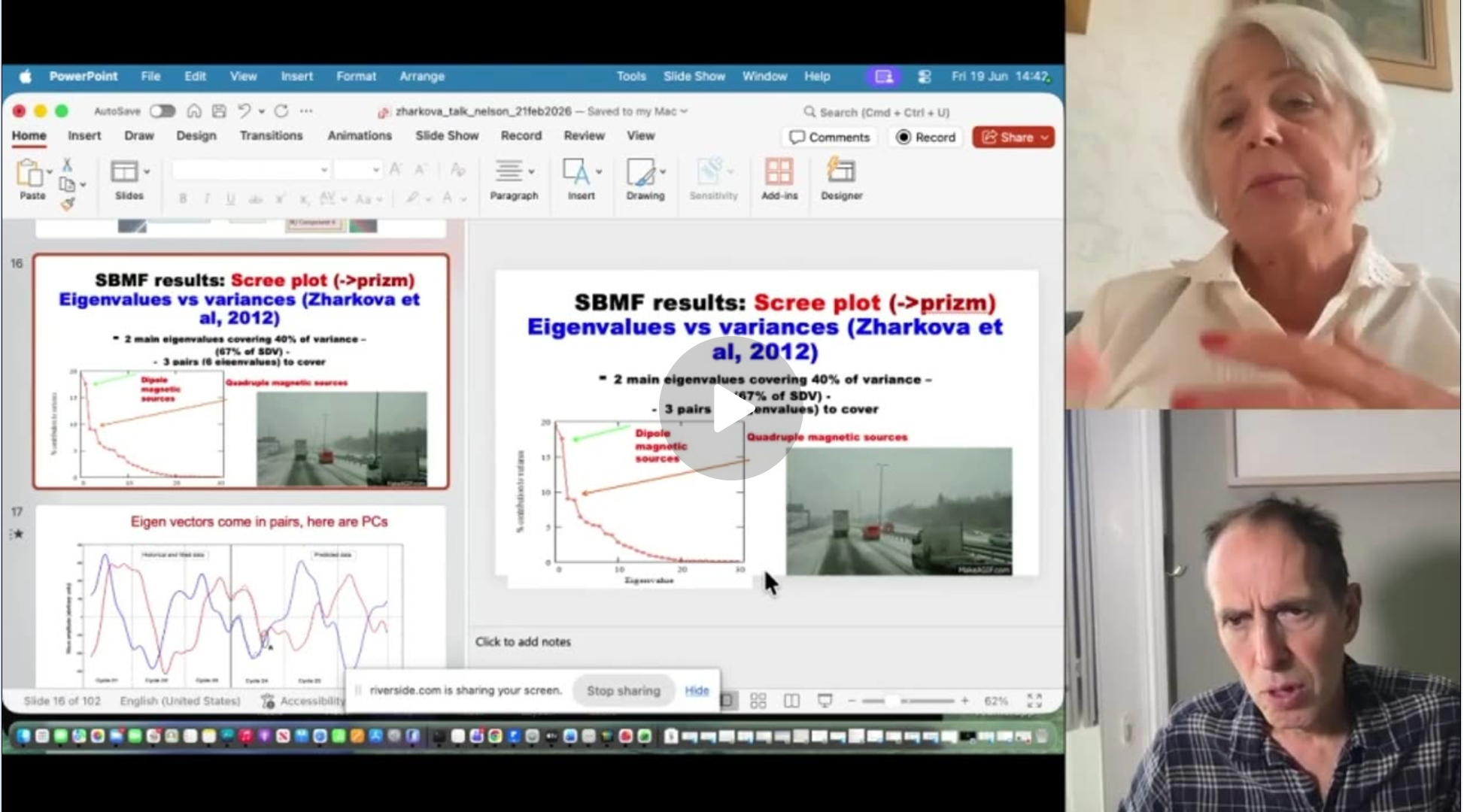
- Zharkova's team applied principal component analysis (PCA) to the background magnetic field of the Sun, using it analogously to a prism splitting white light into a spectrum.
- They derived eigenvectors and eigenvalues — effectively the natural oscillation frequencies of the Sun.
- They discovered that the Sun has not one but two dynamo waves that interfere:
- When in phase: amplitude doubles (stronger solar activity)
- When in anti-phase: amplitude cancels to near zero (grand solar minimum)
- The resulting summary curve closely matches observed sunspot numbers and can be used as a secondary index of solar activity.
- This work was first published in 2015 and updated in 2022 to include Solar Cycle 24.
8. Prediction of a Modern Grand Solar Minimum
| Parameter | Detail |
|---|---|
| Start | ~2020 (five years prior to interview) |
| Duration | ~33 years (approximately three solar cycles) |
| Remaining at time of interview | ~28 years |
| Expected depth | Comparable to the Byzantine Grand Solar Minimum (~500–600 AD), not as extreme as the Maunder Minimum (which lasted ~six cycles) |
| Expected minimum period | Between Cycles 25–26, around 2031–2033 — described as the coldest point |
| Envelope cycle period | ~350 years (range 330–380 years) between grand solar minima |
- The summary curve, calculated backwards 1,200 years and forwards to 3,000, reportedly aligns with known historical minima: Maunder, Dalton, Wolf, and others.
9. Solar Inertial Motion and the 2,100-Year Cycle
- When extending the summary curve to 120,000 years, Zharkova's team discovered that the zero-line of the magnetic field oscillates with a period of approximately 2,100 years.
- They attributed this to solar inertial motion — the movement of the Sun around the barycentre (centre of mass) of the solar system, driven by the gravitational pull of large planets.
- The Sun–Earth distance varies by approximately 0.200 astronomical units over two millennia due to this motion.
- In the current millennium, the Sun is closer to Earth from January to June, which heats the southern hemisphere oceans, transferring heat globally via El Niño/La Niña cycles.
- This mechanism is proposed as an alternative explanation for observed warming, distinct from CO2-driven models.
- A paper on this topic published in Scientific Reports (Nature) was retracted, which Zharkova attributes to pressure from proponents of anthropogenic global warming.
10. Critique of CO2-Driven Climate Models
- Zharkova claims to have identified an error in radiative transfer code used in climate models: an integral was allegedly replaced by a simple summation without proper weighting, leading to overestimation of CO2 heating.
- She characterises CO2 as a "trace gas" that "cannot heat the atmosphere physically" according to her own radiative transfer calculations.
- She criticises specific climate scientists, naming individuals at Reading University and East Anglia University, and references the Climategate emails.
11. Magnetic Pole Reversals
| Body | Reversal period | Current status |
|---|---|---|
| Sun | ~11 years (part of the solar cycle) | Regular, non-catastrophic |
| Earth | ~6,000 years | Appears to be approaching a reversal — North Pole migrating toward Siberia, South Pole toward Argentina |
- Zharkova states that Earth's magnetic pole reversal would not be catastrophic — the main risk is temporary GPS disruption. Earth's orbit and rotation are governed by gravitation, not magnetism.
- She notes that planets without magnetic fields (e.g., Mars) lack strong atmospheres.
12. Observed Cold-Weather Events (cited as evidence)
Zharkova cites recent unusual cold events as supporting evidence for her prediction:
- Snow in Queensland, Australia and South Africa (giraffes and lions seen in snow)
- 46 deaths from frost in Japan due to heavy snow and inadequate housing insulation
- Snow in Florida and the southern United States
- Antarctica cold record exceeding −76.4 °C
- Snow in the Alps, New Zealand, and Australia in March (their autumn)
13. Allegations of Scientific Suppression and a Russian Intelligence Theory
- Zharkova alleges that her research has been systematically suppressed, including having a Nature paper retracted and being publicly disparaged by other scientists.
- She names Usoskin (from Moscow) and Krivova (at Max Planck Institute, originally from Russia) as key antagonists who dispute her work while promoting the view that solar radiation is constant.
- She speculates — explicitly labelled as her own suspicion — that Russian intelligence may be promoting the anthropogenic global warming narrative to encourage Western economies to destroy their own energy sectors through net-zero policies, leaving them vulnerable to growing economies (Russia, China, India).
- She draws a parallel to Yuri Bezmenov, the KGB defector who described Soviet tactics for undermining the West.
14. Practical Advice
- Zharkova advises people to install wood/coal-burning stoves in their homes, as electric and gas heating may be insufficient during the coming cold period.
- She notes that people in multi-storey housing would be particularly vulnerable.
- Her website is solargsm.com, where she publishes her research papers (as PDFs) and information about solar activity and energetic particle problems.
Important Caveats
This transcript presents Zharkova's claims as stated in the interview. Several of her assertions — particularly regarding CO2's role in climate, the alleged errors in climate model code, the retraction of her Nature paper, and the theory about Russian intelligence involvement — are contested by mainstream climate science and are presented here as her views, not as established fact. The interview format (a sympathetic host on a sceptical podcast) did not include substantive challenge to these claims.