Vexslags
The original term is vekslák (plural veksláci), which is sometimes anglicized or misspelled phonetically as "vexslags" or "vekslaks". It is a prominent Czech and Slovak slang term describing a specific type of black-market hustler, money changer who operated in socialist Czechoslovakia from the late 1960s until the fall of communism in 1989.
The Shadow Economy of the Vekslák
To understand the necessity of the vekslák, one must look at the economics of the Eastern Bloc. Ordinary citizens were paid in Czechoslovak crowns (CSK), a soft currency that was not freely convertible on international markets. The state strictly controlled access to foreign, "hard" currencies like the DEM (West German mark) or USD.
However, the state also ran a chain of retail stores called Tuzex. These stores sold imported Western goods that were otherwise unavailable, such as denim jeans, quality cosmetics, foreign tape recorders, and even imported cars. Tuzex stores did not accept normal CSK. They only accepted foreign hard currency or special state-issued vouchers colloquially known as bony.
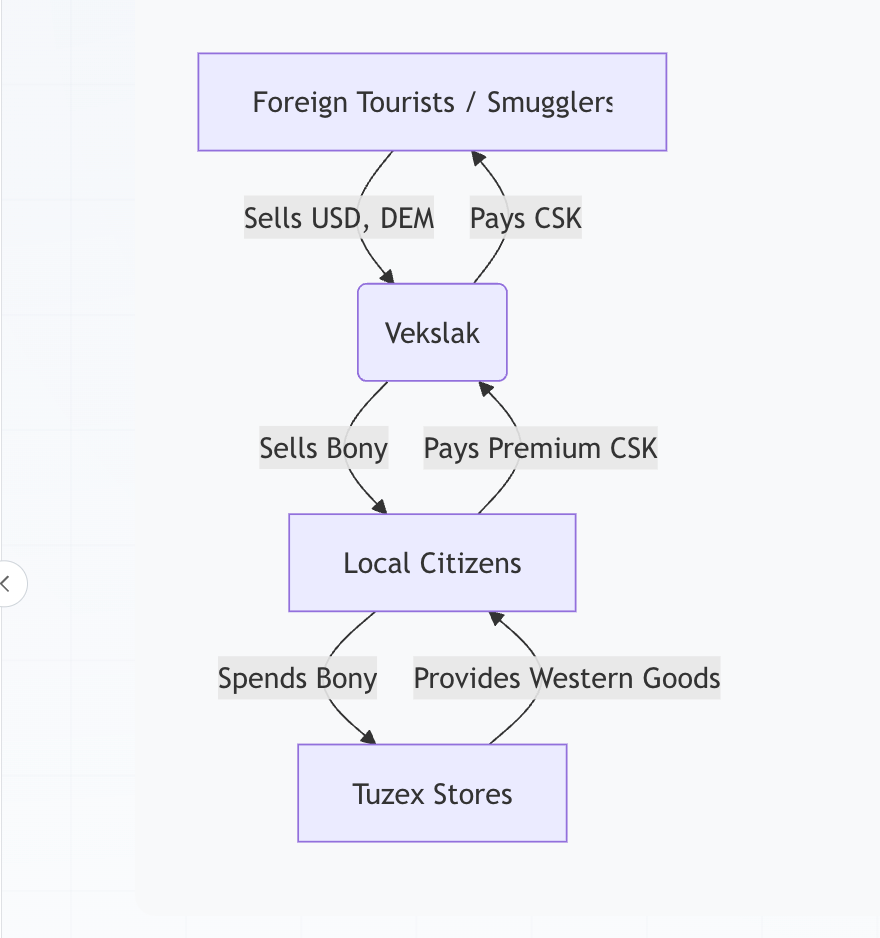
This created a massive black market. Foreigners visiting Czechoslovakia—or citizens with permits to work abroad—had access to hard currency and bony. The vekslák acted as the broker, buying foreign currency from tourists and selling bony at a massive markup to everyday Czechoslovak citizens who wanted to buy Western goods.
| Term | Meaning | Role in Economy |
|---|---|---|
| Tuzex | State retail enterprise | Authorized sellers of Western and luxury consumer goods |
| Bony | Special Tuzex vouchers | The primary exchange medium required to shop at Tuzex stores |
| Hard Currency | Western fiat like DEM or USD | Illegal for private citizens to freely trade but highly desired |
| CSK | Czechoslovak Crown | The standard fiat currency used for everyday wages and basic needs |
Cultural Impact and Stereotypes
Because of their control over highly desired goods, veksláci accumulated significant, albeit illegal, wealth. They developed a very specific cultural stereotype and dress code, often wearing the exact Western goods they controlled access to.
Typical characteristics of a 1980s vekslák included:
- Washed denim jeans and denim jackets
- Leather jackets and Western-brand sneakers
- Distinctive hairstyles, often a mullet
- Heavy gold chains and digital watches with calculators
- Operating openly in front of Tuzex stores, tourist hotels, and money exchanges, repeatedly whispering their catchphrase to passersby:
- "Bony, bony, marky, bony..." (Vouchers, vouchers, marks, vouchers...)
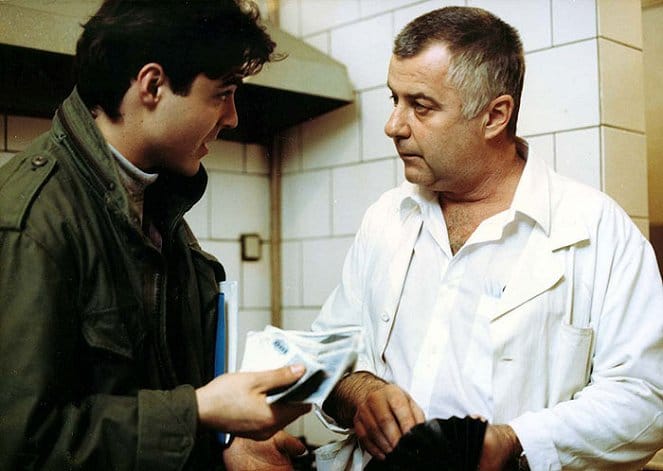
Their lifestyle was immortalized in the cult-classic 1987 Czechoslovak film Bony a klid, which offered a gritty look into their underworld operations, alliances, and clashes with law enforcement.
Economic Mechanics
The typical transaction loop of the vekslák was simple but highly profitable. The mathematical margin they effectively secured can be represented dynamically, but a basic transaction logic applied:
Post-1989 Evolution
Following the Velvet Revolution in 1989, Czechoslovakia transitioned to a free-market economy. The CSK eventually became fully convertible (later splitting into the Czech koruna and Slovak koruna), and Western goods became freely available in regular shops. Tuzex and bony were rendered obsolete.
With their original business model destroyed, the veksláci adapted. Because they were among the few citizens who already understood capitalist concepts like supply, demand, margins, and currency exchange—and because they possessed starting capital—many transitioned successfully into the new economy. While some became legitimate businessmen and politicians in the 1990s.