Visionary
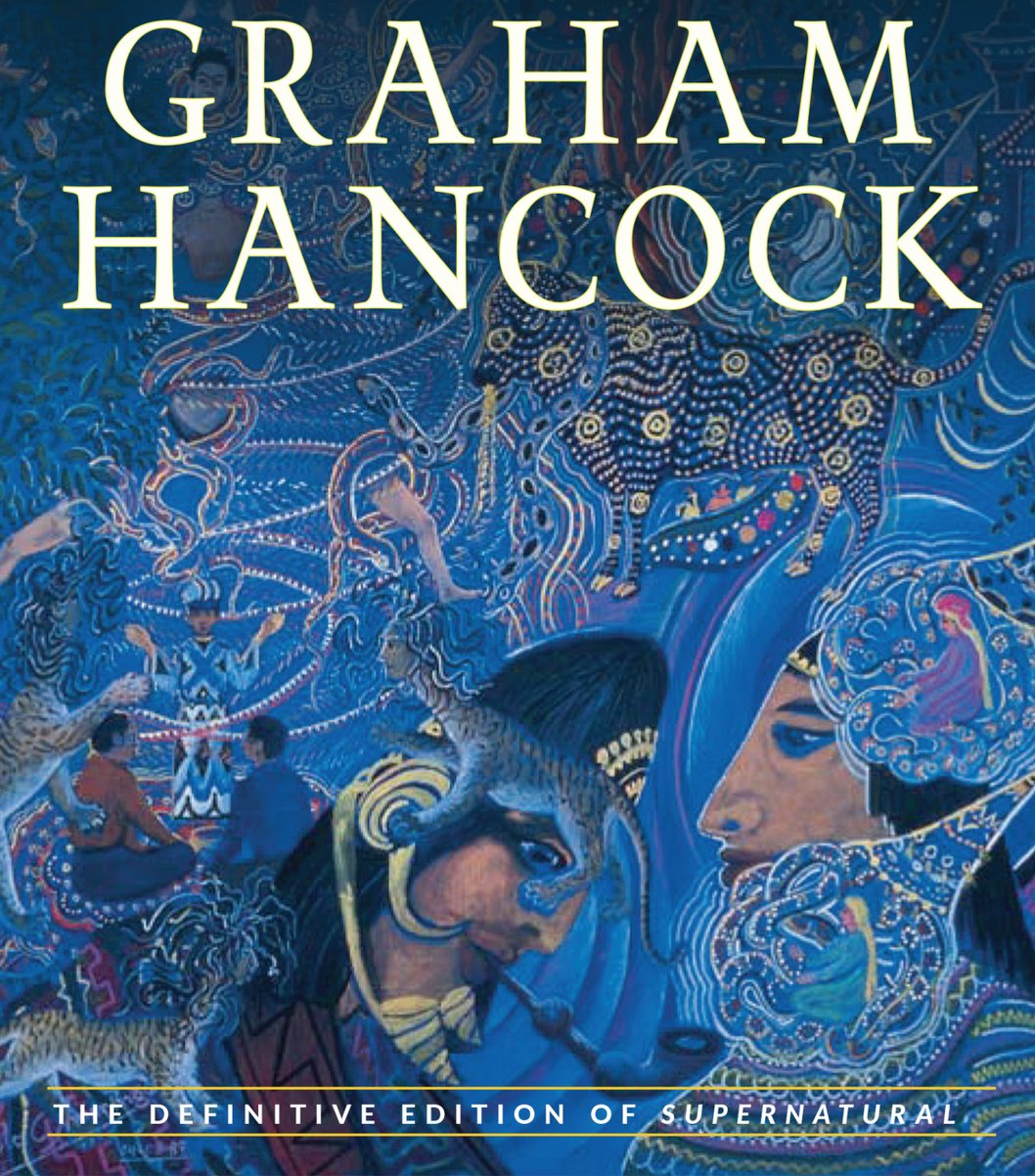
Visionary is Graham Hancock's 2022 book — but it isn't a new work so much as the "definitive edition" of his 2005 book Supernatural: Meetings with the Ancient Teachers of Mankind. It restores the original unabridged text, adds a new introduction, and reinstates chapters cut from the earlier paperback [1]. It sits apart from his famous "lost Ice Age civilisation" books (Fingerprints of the Gods, Magicians of the Gods): this one is about consciousness, cave art and psychedelics rather than Atlantis-style archaeology.
The core puzzle
Hancock starts from what he calls the "before-and-after moment": fewer than 50,000 years ago humans produced no art, religion or sophisticated symbolism — then, abruptly, fully formed creativity appears, a transition often described as "the greatest riddle in human history" [1:1]. His question is what caused it.
The argument and the journey
The book is built as a travelogue-cum-detective story:
- Prehistoric caves — He visits painted caves in France, Spain and Italy and rock shelters in southern Africa, examining the peculiar "therianthropes" (part-human, part-animal figures) that dominate Upper Palaeolithic art [1:2].
- Shamanism and altered states — He draws heavily on archaeologist David Lewis-Williams' neuropsychological model, which holds that cave art records visions seen in trance states, and argues visionary experience shaped the emergence of modern cognition [2].
- Ayahuasca in the Amazon — He drinks ayahuasca with Indigenous shamans and reports encountering "supernatural beings" visually identical to the cave-art hybrids. He notes mescaline produces similar encounters [1:3].
- DMT and consciousness research — He engages with DMT research (including Rick Strassman's work) and the idea, held by some researchers on the fringe of consciousness studies, that such hallucinations may be perceptions of other "dimensions" rather than pure neurology [1:4][3].
From this he poses his central speculative question: could the "supernaturals" of the caves have been the ancient teachers of mankind — and could human evolution be something more purposive and intelligent than the "blind, meaningless" Darwinian process? [1:5]
Chapter by Chapter
A caveat up front: the book runs 640 pages with endnotes, and I could verify the full table of contents and page numbers but not read every page of text. The chapter descriptions below are accurate to the book's argument and sequence; where I'm inferring detail rather than quoting, treat it as a reconstruction of the through-line rather than a verbatim précis.
The book is in three parts plus epilogue and appendices.
Part I — The Hook (pp. 3–56)
| Ch. | Title | What happens |
|---|---|---|
| 1 | The Plant That Enables Men to See the Dead (p. 3) | Opens in the Amazon. Hancock drinks ayahuasca with Tukano and other Indigenous shamans, and hears the local name for the brew — the "vine of souls" / the plant that lets men see the dead. Establishes his two-track method: personal experience plus library research. |
| 2 | The Greatest Riddle of Archaeology (p. 11) | The "before-and-after moment." For hundreds of thousands of years hominins left no art, burial with goods, ornament or symbolism; then, roughly 40,000–50,000 years ago, the whole package appears essentially fully formed. He canvasses orthodox explanations — a genetic mutation enabling language, neural reorganisation, population pressure — and finds them thin [^ca25ed#43] |
| 3 | Vine of Souls (p. 27) | The chemistry and phenomenology of ayahuasca: DMT plus MAO inhibitors, the purge, the sense of being shown things by an intelligence. He introduces Pablo Amaringo's visionary paintings, Benny Shanon's taxonomy of ayahuasca visions, and states his working hypothesis — that the content of these visions resembles the content of Ice Age art. |
Part II — The Caves (pp. 57–262)
This is the empirical heart of the book, and the strongest section.
| Ch. | Title | Core content |
|---|---|---|
| 4 | Therianthropy (p. 57) | The hybrid human-animal figures — the "Sorcerer" of Trois-Frères, the lion-man of Hohlenstein-Stadel — that dominate the earliest figurative art. Hancock's point: Palaeolithic artists weren't mainly painting dinner. They were painting beings that don't exist. |
| 5 | Riddles of the Caves (p. 79) | Tour of Chauvet, Lascaux, Altamira, Pech Merle and Cosquer: perspective, shading, animation, use of cave shape — technical mastery from the very first. Also the strange non-figurative repertoire: hand stencils, dots, tectiforms, meanders. |
| 6 | The Shabby Academy (p. 113) | His polemic. Hancock argues archaeology defends a narrow materialist orthodoxy, dismisses shamanic readings, and treats the "art for art's sake" or "hunting magic" explanations as settled when they aren't. This is the chapter critics regard as the book's weakest — a caricature of the field rather than an engagement with it. |
| 7 | Searching for a Rosetta Stone (p. 135) | The search for a decoding key. He turns to living rock art traditions — above all the San of southern Africa — as the ethnographic analogue that might unlock the European caves. |
| 8 | The Code in the Mind (p. 165) | The pivotal chapter. David Lewis-Williams and Thomas Dowson's neuropsychological model: trance proceeds through stages — entoptic geometric forms (grids, dots, spirals, zigzags), then construal of those forms into objects, then full iconic hallucinations of animals, people and hybrids — and the same forms appear in cave art worldwide because they're hard-wired in the human nervous system. Hancock adopts this largely wholesale. |
| 9 | Serpents of the Drakensberg (p. 197) | Fieldwork in South African rock shelters: San paintings of serpents, eland and therianthropes, read against recorded San testimony about the trance dance and the "threads of light" that lead to the spirit world. |
| 10 | The Wounded Healer (p. 225) | Shamanic initiation as a universal pattern: the call, sickness, dismemberment, death and rebirth, the return with healing power. Cross-cultural survey from Siberia to the Americas. |
| 11 | Voyage into the Supernatural (p. 247) | What the shaman actually does on the journey: soul flight, ascent and descent through layered worlds, negotiation with spirit helpers and dangerous entities. Hancock insists this is travel, described consistently, not metaphor. |
| 12 | Shamans in the Sky (p. 263) | Brings the model back to the Palaeolithic: cave as portal, painted wall as membrane, the artist as traveller. He argues Upper Palaeolithic religion is recognisably shamanic in structure. |
Part III — Widening the Case (pp. 263–474)
Here the argument stops being about caves and starts stacking up "independent databases" of entity encounters.
| Ch. | Title | Core content |
|---|---|---|
| 13 | Spirit Love | Sexual and reproductive encounters with spirits: the shaman's spirit spouse, incubi and succubi, spirit marriages. He then sets these beside modern UFO abduction accounts — the Villas-Boas case, David Jacobs' Secret Life interviews — where abductees describe being made to nurse or breed hybrid children. |
| 14 | The Secret Commonwealth | Jung's 1958 Flying Saucers (UFOs as a modern myth expressed "in the form of visions"); Jacques Vallée's Passport to Magonia (1969), which argues the modern saucer phenomenon is the fairy faith under a new name — "we are prying into the affairs of the Secret Commonwealth"; the Reverend Robert Kirk's 1691 treatise on elves and fairies, and Kirk's own disappearance in 1692, believed locally to be a fairy abduction; fairy midwives and wetnurses, missing time, and time running differently in the otherworld; the "sons of God" of Genesis 6 [1] |
| 15–16 | (titles not verifiable) | The remaining stretch before the DMT material continues this comparison — extending the fairy/alien/abductee triad and confronting the objection that these are all just culturally shaped hallucination. This is where the book is at its most speculative and least evidence-bound. |
| 17 | Tuning in to Channel DMT (p. 355) | DMT as the common denominator: its presence in ayahuasca, its endogenous occurrence in the human body, Rick Strassman's clinical trials and the "spirit molecule" framing. |
| 18 | Amongst the Machine Elves (p. 365) | The phenomenology of the breakthrough dose — Terence McKenna's "self-transforming machine elves," the sense of autonomous intelligences, the feeling of being known by something. Hancock's own experiences and those of other volunteers. |
| 19 | Ancient Teachers in Our DNA? (p. 391) | The speculative leap, framed as a question: could these entities be genuinely external — inhabitants of another dimension accessed via a neurochemical doorway — and could such contact have been the catalyst for the "before-and-after moment"? |
| 20 | The Hurricane in the Junkyard (p. 405) | His attack on orthodox neo-Darwinism: the claim that random mutation plus natural selection cannot plausibly account for the sudden arrival of symbolic consciousness, using Hoyle's tornado-in-a-junkyard image. He leans toward purposeful or directed evolution. |
| 21 | The Hidden Shamans (p. 421) | Psychedelics in history and their suppression: the Eleusinian Mysteries and kykeon, soma, witches' flying ointments, ergot, the medieval and modern campaign against visionary experience. |
| 22 | Flesh of the Gods (p. 451) | McKenna's "stoned ape" hypothesis — psilocybin mushrooms in the African savannah shaping hominin cognition — and the broader argument that psychoactive plants are a driving force in the emergence of mind. |
| — | The Mysteries (p. 475, epilogue) | The synthesis. The "supernaturals" of the caves as the ancient teachers of mankind; consciousness as something the brain receives rather than produces; an ethical coda about what it would mean to take visionary experience seriously. |
Back matter
| Section | Page | Content |
|---|---|---|
| Afterword | 499 | Written for this edition; revisits the argument roughly fifteen years on |
| Appendix: Critics and Criticisms of David Lewis-Williams | 505 | His defence of the neuropsychological model against its archaeological critics — notably Paul Bahn and Patricia Helvenston |
| Appendix: Psilocybe semilanceata — A Hallucinogenic Mushroom | 525 | Mycological note on the "liberty cap," one of the species central to Ch. 22 |
| Notes and references | 539 | ~64 pages |
| Index | 603 |
The publisher's TOC confirms these titles and page numbers [2], and the part divisions (Part I chs. 1–3, Part II "The Caves" from ch. 4) come from the ebook's own contents listing [3].
How to read it
The book has a clear structural logic that's worth seeing: Part II is the argument, Part III is the extrapolation. Chapters 4–12 are a genuinely useful synthesis of Lewis-Williams' work on trance and cave art, whatever you make of the conclusions. From Chapter 13 onward the method changes — instead of evidence and inference, it becomes pattern-matching across three bodies of testimony (shamanic, fairy-folkloric, abduction), with no independent way to adjudicate between "same entities" and "same brain producing culturally familiar scripts." Chapter 20 in particular departs from the book's own evidentiary standards; it's an argument about evolutionary theory rather than an application of it.
If you want the shortest useful path: chapters 2, 8, and 14 are the load-bearing ones — the puzzle, the mechanism, and the cross-cultural claim.
References