Watermelons
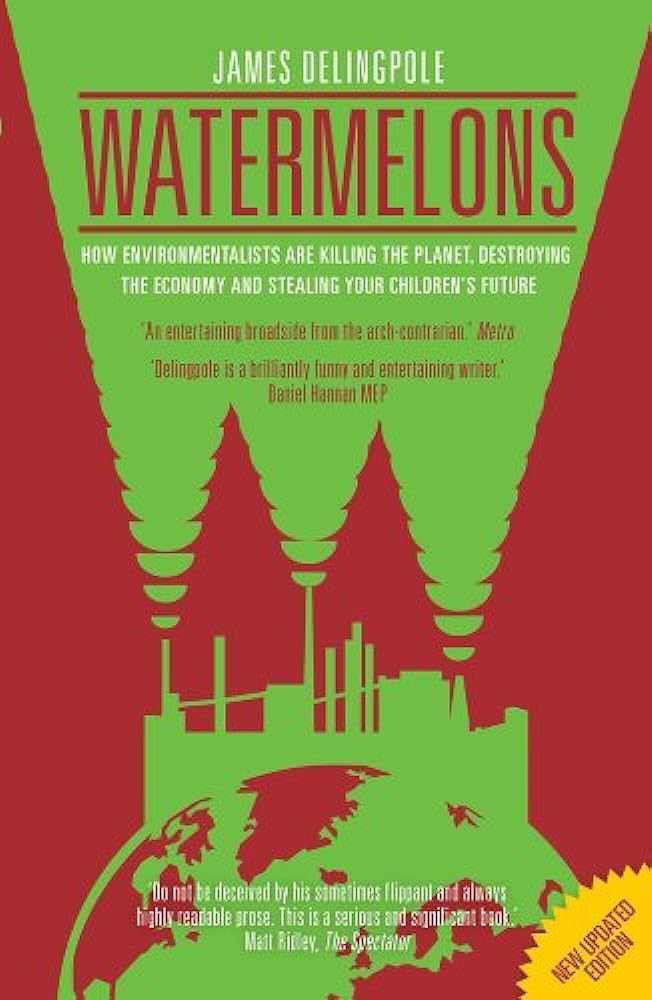
Full title: Watermelons: How Environmentalists are Killing the Planet, Destroying the Economy and Stealing Your Children's Future (first published 2011, updated 2012 and 2024)
The Core Thesis
The book's title is its central metaphor: the modern environmental movement is "green on the outside, red on the inside" — environmental concern serves as a respectable cover for neo-Marxist, anti-capitalist, anti-liberty ideology. After the collapse of Soviet communism in 1989, Delingpole argues, leftist activists migrated into green organisations, carrying their authoritarian objectives with them. He claims these "watermelons" don't want to save the world — they want to rule it.
 James Delingpole (Author) Format: Paperback
Click to get your own copy of the book
Key Arguments
1. Climategate & Scientific Misconduct
The November 2009 leak of emails from the University of East Anglia's Climatic Research Unit revealed, Delingpole argues, systematic data manipulation, suppression of dissenting research, destruction of evidence to evade FOI requests, and private admissions that publicly promoted claims were unsupportable. The scientists involved were central to the IPCC process, not marginal figures.
2. The Hockey Stick Graph Was Flawed
Michael Mann's famous graph — showing flat temperatures for a millennium then a dramatic modern uptick — became the centrepiece of the catastrophic climate case despite being, Delingpole contends, methodologically worthless: the statistical algorithm would produce hockey-stick shapes from random noise, and the graph erased well-documented historical climate events like the Medieval Warm Period and Little Ice Age. When Steve McIntyre and Ross McKitrick exposed these flaws, Mann allegedly responded with smears rather than factual rebuttals.
3. "Post-Normal Science" Abandoned Scientific Integrity
Delingpole argues that the framework of "Post-Normal Science" (developed by Jerome Ravetz and Silvio Funtowicz) gave intellectual cover for climate scientists to abandon proper methodology — hypothesis testing, replication, and willingness to discard failed theories — in favour of politically motivated communication, justified by the claim that the stakes were too high for normal science.
4. Foundational Environmental Texts Were Wrong
Rachel Carson's Silent Spring (on DDT), Paul Ehrlich's The Population Bomb (predicting mass famine), and James Lovelock's Gaia Hypothesis all made predictions that proved spectacularly wrong, Delingpole argues, yet their authors remain honoured figures because advancing the green agenda matters more than accuracy within the movement.
5. The Club of Rome Sought Environmental Crises as Political Tools
The Club of Rome's 1993 publication The First Global Revolution explicitly stated: "In searching for a new enemy to unite us, we came up with the idea that pollution, the threat of global warming, water shortages, famine and the like would fit the bill… the real enemy, then, is humanity itself." Delingpole presents this as a frank admission that environmental threats were selected for their political utility.
6. Maurice Strong Built the Architecture of Global Environmental Governance
Canadian entrepreneur Maurice Strong chaired the 1972 UN Conference on the Human Environment, became the first director of UNEP, and organised the 1992 Rio Earth Summit. Delingpole highlights Strong's statements that ballot-box democracy "may need to be modified" and that national sovereignty would yield to global environmental cooperation — revealing, he argues, the authoritarian underpinnings of international environmental policy.
7. Agenda 21 Implements Global Governance Locally
Signed by 179 nations at Rio, Agenda 21 operates through stealth, Delingpole claims — relabelling its prescriptions as "comprehensive planning" or "smart growth" to avoid public opposition. Local planning boards implement zoning regulations and property restrictions originating from international agreements, bypassing democratic processes.
8. Misanthropy Pervades Elite Environmental Thinking
Delingpole catalogues disturbing statements from prominent environmental figures: Ted Turner calling a 95% population reduction "ideal," Prince Philip wishing to reincarnate as a deadly virus, Club of Rome co-founder Alexander King regretting that DDT reduced malaria deaths, and others comparing humans to parasites and maggots. He argues these reveal a strain of thought that regards human beings as vermin to be culled.
9. Green Policies Have Real and Mounting Economic Costs
Delingpole cites research from Spain finding that for every "green job" created by subsidy, 2.2 jobs were destroyed elsewhere. The UK Climate Change Act commits Britain to £18.3 billion annually through 2050. Wind farms require conventional backup and transfer wealth from ordinary consumers to wealthy landowners. Feed-in tariffs raise energy bills and create fuel poverty.
10. The Debate Is Ultimately Freedom vs. Control
Delingpole frames the climate debate as a clash of irreconcilable worldviews: one viewing humans as creative problem-solvers who flourish in freedom, the other viewing humanity as a menace requiring containment by enlightened experts beyond democratic accountability. He argues there is no middle ground — the choice is between optimism and pessimism, freedom and tyranny.
In Brief
Watermelons argues that the environmental movement — particularly the campaign over climate change — is not primarily about science or saving the planet, but is an ideological project rooted in anti-capitalist, anti-human, and authoritarian thinking. Delingpole contends that flawed science (the hockey stick, Climategate), failed predictions, misanthropic elite attitudes, and mounting economic costs all point to a movement seeking control rather than conservation.