What has the Government done
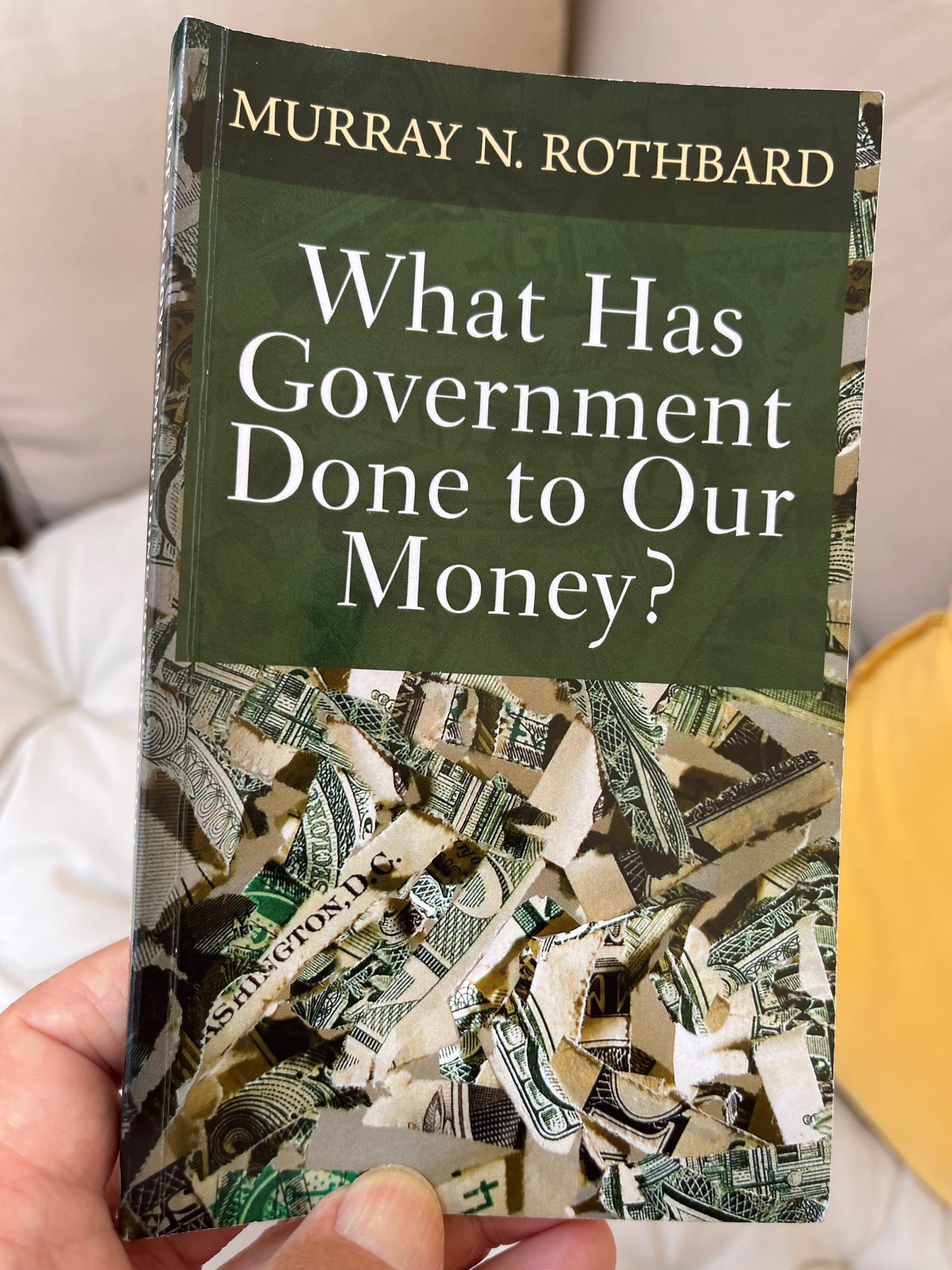
What Has Government Done to Our Money? is one of the most influential and accessible works in the Austrian School of Economics tradition. Originally published in 1963 (with an earlier version titled Money, Free and Unfree in 1962), it's a concise but powerful critique of government intervention in money and banking, and a passionate case for returning to a gold standard and free-market money [1]
Chapter-by-Chapter Overview
1. The Natural Evolution of Money — From Barter to Gold
Rothbard begins with a first-principles explanation of how money arises spontaneously from the market, not from government decree. Starting from barter — which suffers from the "double coincidence of wants" problem — societies gradually converged on commodity money, especially gold and silver, because of their durability, divisibility, portability, and universal recognizability. The gold standard emerged organically: paper certificates representing actual gold held in reserve made trade more efficient while preserving the commodity's discipline on the money supply [2].
2. Government Intervention — Centralized Control and Manipulation
Governments seized control of money through the establishment of central banks (e.g., the Federal Reserve). These institutions manage the money supply, set reserve requirements, and manipulate interest rates — ostensibly for stability, but in practice distorting the natural market. Rothbard argues that these tools allow governments to inflate the money supply, devalue purchasing power, and engage in deficit spending financed by money creation [2:1].
3. The Consequences — Inflation and Economic Distortions
Increasing the money supply does not enter the economy evenly — it creates what the Austrian school calls the Cantillon Effect, confusing price signals and misleading investors. Rothbard argues this produces "wasteful booms" followed by painful readjustments (recessions/depressions) rather than healthy, sustainable growth [1:1]. Historical examples like Weimar Germany and Zimbabwe illustrate the catastrophic endgame of unchecked monetary expansion [2:2].
4. Fractional Reserve Banking — Risks and Realities
Banks that hold only a fraction of deposits in reserve while lending out the rest create a "money multiplier effect" — effectively creating money out of thin air. This inflates the money supply beyond what actual savings support, making the system vulnerable to bank runs and contributing to the boom-bust cycle. Government-backed central banks act as "lenders of last resort," which Rothbard sees as enabling and reinforcing this inherently fragile system [2:3].
5. The Case for Sound Money — Return to the Gold Standard
Rothbard argues that a gold standard inherently restricts the government's ability to inflate the money supply arbitrarily. Under fiat money, nothing limits how much currency can be created; under a gold-backed system, the money supply is tethered to physical gold reserves. The transition would require: (a) halting inflationary central banking policies, (b) legally mandating that new currency be backed by gold, and (c) implementing a redemption process allowing individuals to exchange fiat currency for gold [2:4].
6. Practical Benefits — Individuals and Economies Under Sound Money
- For individuals: Sound money preserves purchasing power, encouraging genuine saving and long-term financial planning rather than speculation on inflation hedges.
- For businesses: Stable currency values enable reliable long-term investment decisions.
- For economies: Less prone to artificial booms and busts since interest rates and money supply are determined by the market, not policymakers.
- For governments: Fiscal discipline is imposed — governments can no longer print money to finance deficits, forcing more responsible spending [2:5].
Key Themes & Arguments
| Theme | Rothbard's Position |
|---|---|
| Origin of money | Emerged spontaneously from the market (not from the state) |
| Gold as money | Gold won out naturally due to its physical properties and scarcity |
| Central banking | A mechanism for government control and inflation, not stability |
| Fractional reserve banking | Inherently fraudulent — creates fictitious "warehouse receipts" for gold that doesn't exist |
| Inflation | Not a "price phenomenon" but a money supply phenomenon — caused by government expanding the currency |
| Fiat money | Unbacked paper money allows unlimited government power to devalue citizens' wealth |
| Solution | Separate money and state; return to a 100% gold-backed dollar determined by the free market |
The "9 Stages of Monetary Breakdown"
A popular distillation of Rothbard's argument (sometimes attributed to Business Insider's Gregory White in 2010) outlines the progressive destruction of sound money:
- Gold coinage — money starts as a commodity
- Government monopolizes minting — standardization becomes state control
- Paper receipts for gold — convenience, but a step toward abstraction
- Government sets "exchange rates" — price controls between metals (bimetallism)
- Fractional reserve banking — banks issue more receipts than gold on deposit
- Central bank — government creates a lender of last resort to enable further inflation
- Suspension of gold redemption — government cuts the link to gold
- Fiat paper money — currency has no commodity backing at all
- Runaway inflation / currency collapse — the endgame of fiat money