You are the exit liquidity

Core Thesis
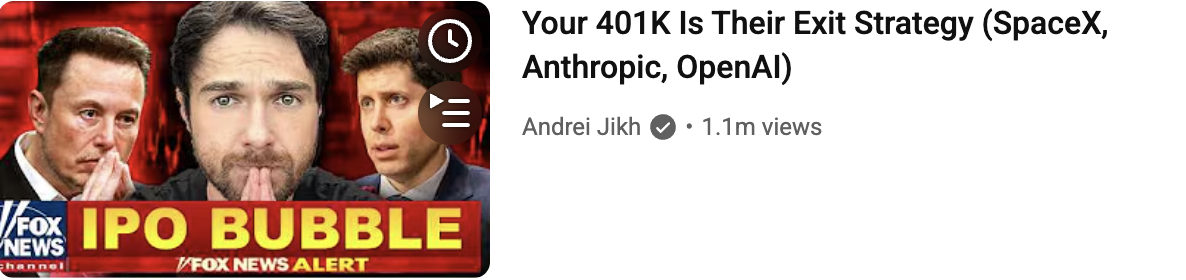
Jikh argues that upcoming IPOs for SpaceX, OpenAI, and Anthropic—collectively valued at approximately $4 trillion—will constitute one of the largest financial bubbles in history. He contends that rule changes across major stock indices are being engineered to force passive retirement accounts (401Ks, pension funds) to automatically purchase these shares, providing "exit liquidity" for early insiders at peak valuations.
Significant and Surprising Points
1. The Rule Changes (The "Fast Entry Rule")
On 1 May 2025, NASDAQ introduced three critical changes:
| Change | Old Rule | New Rule | Impact |
|---|---|---|---|
| Waiting period | Up to 1 year (next yearly review) | 15 trading days | Companies enter indices almost immediately post-IPO |
| Float requirement | Minimum 10% public float | No minimum | SpaceX's 4–5% float now qualifies |
| Hidden multiplier | N/A | 3× artificial inflation for floats <20% | A 4% float treated as 12%; 5% as 15% |
This forces index funds to buy more stock than available supply would justify.
Other indices made similar changes:
- FTSE Russell: Inclusion after just 5 days
- S&P: Comparable fast-track rules
Jikh notes the suspicious timing: "every single one of these rule changes was announced just weeks and months before the biggest IPOs in human history" (lines 93–95).
2. SpaceX's $1.75 Trillion Valuation vs. Financial Reality
- Would make SpaceX more valuable than all American defence contractors combined on day one
- Largest IPO in human history, exceeding Saudi Aramco (2019)
- Yet SpaceX lost $5 billion last year (line 22)
SpaceX comprises three distinct businesses:
| Business | Revenue/Status |
|---|---|
| Rockets (NASA, government contracts, reusable rockets) | ~$4 billion revenue |
| Starlink (satellite internet, 10 million subscribers, 150 countries) | $11.4 billion revenue, 63% profit margins |
| xAI (Elon's AI company) | Burns over $1 billion per month |
Starlink and rockets are profitable; xAI "lights it on fire" (line 141).
3. The "Earnings Bubble" and Circular Accounting Trick
Jikh describes a circular money flow inflating paper profits:
"Big tech invests into AI startups. The AI startups then use that money to rent computing power back from big tech. Big tech books the investment gains as profit and then uses that profit to justify spending even more. The money is mostly going in a circle." (lines 202–205)
Financial Times analysis of capital expenditure (capex) versus AI revenue (2024–2030), under most generous assumptions (zero costs, no salaries, no electricity):
| Company | Implied Return on AI Investment |
|---|---|
| Microsoft | 9.2% |
| −15.7% | |
| Meta | −28.8% |
| Oracle | −35.6% |
| Amazon | 7.2% |
These companies issued over $150 billion in corporate bonds this year alone—more than double two years prior (lines 186–188).
OpenAI and Anthropic spending commitments:
- OpenAI: $280 billion to Microsoft, $138 billion to Amazon
- Anthropic: $30 billion to Microsoft, $100 billion to Amazon
These represent:
- 50% of Microsoft's entire revenue backlog
- 54% of Oracle's
- 51% of Amazon's (lines 199–201)
4. Historical Parallels: IPOs as Market Peaks
Financial Times chart cited (line 222) showing culturally significant IPOs versus S&P 500 performance:
| IPO | Market Outcome |
|---|---|
| Xerox | Market peaked right after |
| Ford | Market peaked right after |
| McDonald's | Market peaked right after |
| Apple | Market peaked right after |
| Goldman Sachs | Market peaked right after |
| Blackstone | Market peaked right after |
Jikh's interpretation: "the IPO is rarely about the company needing money... It's almost always about the seller needing a buyer" (lines 231–232).
Scale comparison: SpaceX, OpenAI, and Anthropic IPOs will raise as much as all 300 dot-com IPOs from 2000 combined (adjusted for inflation) (lines 235–236).
5. The "Earnings Bubble" Distinction
Unlike typical valuation bubbles (high P/E ratios), this may be an earnings bubble:
"In a normal bubble, the stock price goes up while the earnings of the company stays flat... But an earnings bubble... the earnings themselves that are inflated" (lines 247–250)
Historical precedents:
- Homebuilders before 2008: P/E ratios looked reasonable until collapse
- Banks before financial crisis: "Perfectly healthy earnings numbers right until the earnings themselves were shown to be built on assets that were worth a fraction" (lines 258–261)
6. Semiconductor Parallels
Global semiconductor sales have gone "completely parabolic"—a "straight vertical line up" (lines 263–264). Historical pattern: stock price peaks before earnings collapse.
Examples:
- Nvidia, December 2001: Peaked, then fell 83% before earnings caught up
- Nvidia, November 2021: Peaked, fell 53% before earnings caught up
7. Unprecedented Market Concentration
- AI-related stocks: 49% of S&P 500 market cap (41 stocks out of 500)
- Four consecutive record S&P 500 highs on negative market breadth: "literally never happened before in market history" (lines 279–280)
- Index rises while more stocks fall than rise—gains driven by handful of largest companies
8. Macroeconomic Fragility
- US personal savings rate: 2.6% (lowest in 4 years) (line 293)
- Real wages declining
- Top 10% of earners are "the only reason the economy is not in a recession"—holding up half the economy (lines 296–297)
Corporate earnings rising; worker incomes flat. Gap explained by: "Companies are automating their way to higher profits while the people who work for them are starting to make less and less" (lines 303–304).
Researcher quote: "At the limit, firms automate their way to boundless productivity and zero demand" (line 305).
9. Geopolitical Catalyst: Strait of Hormuz
- Closed for 3 months due to Iran war
- ExxonMobil senior vice president (New York conference): oil inventories hit "critically low levels within the next 2 to 3 weeks"
- Estimated oil price: $150–160 per barrel (lines 316–317)
Consequence: Countries needing dollars to pay for oil sell US Treasury bonds → interest rates rise → borrowing more expensive for governments, companies, consumers.
Chart cited: "Since the beginning of the Iran war, wherever oil goes, Treasury yields follow almost perfectly" (lines 327–328).
Early signs:
- Emerging markets sold US treasuries in March at fastest rate since at least 2023
- 27 countries approached World Bank for emergency crisis funding
- Global bond yields breaking out (US, UK, Germany, Japan, Canada)
10. Federal Reserve Dilemma
Kevin Warsh (new Fed Chairman, hired by Trump to lower rates) faces impossible choice:
| Action | Consequence |
|---|---|
| Lower rates into inflation spike | Dollar falls, inflation worsens, bond yields rise higher as confidence erodes |
| Raise rates | Stock market drops, corporate borrowing costs rise, AI spending boom (93% of US GDP growth) faces higher cost of capital |
Market signal: Two-year Treasury yield above federal funds rate for first time in four years—market telling Fed to raise rates, not lower them (lines 338–339).
Pointers to Wrong-Doing
- Rule manipulation for specific beneficiaries: NASDAQ, FTSE Russell, and S&P simultaneously changed inclusion rules weeks before the largest IPOs in history—rules that specifically accommodate SpaceX's low float and would otherwise disqualify it.
- Artificial demand creation: The "hidden multiplier" (3×) legally compels index funds to purchase more stock than supply justifies—forcing retirement accounts to buy at inflated valuations.
- Circular accounting fraud: Big Tech books investment gains from AI startups as profit, which startups then use to rent computing power back from Big Tech—creating "paper illusion" earnings that justify further spending and stock prices.
- Insider exit strategy: The entire mechanism appears designed to allow early investors to sell shares to passive retirement accounts at peak valuations before underlying financial realities become apparent.
- Conflict of interest in index governance: Indices racing to accommodate issuers rather than protect investors—Larry Fink (BlackRock) explicitly stating retirement funds "will be used to build out this AI infrastructure" (lines 7–12).
- Misrepresentation of corporate health: Companies issuing $150 billion in debt to fund loss-making AI investments while reporting inflated earnings from circular transactions—potentially misleading investors about true financial position.
Jikh's Conclusion
Technology (AI, Starlink) is genuine and transformative. However, *"there's a big difference between a technology winning and investors winning" (line 360).
Historical pattern: Initial investors in transformative technologies (railroads, fibre optics) were typically wiped out; subsequent investors buying distressed assets profited. Jikh anticipates similar outcome: "the initial investors... the passive funds that are forced in by these rule changes. They're going to absorb any potential losses" (lines 379–380).
Actionable Advice Retained
- Understand what your index funds actually own—they will soon own SpaceX, OpenAI, and Anthropic at "extremely unfavourable entry points"
- Diversify across multiple outcomes—no certainty which scenario unfolds
- Know where your money should be invested to protect against all possible outcomes (premium content referenced)