You cannot unsee it
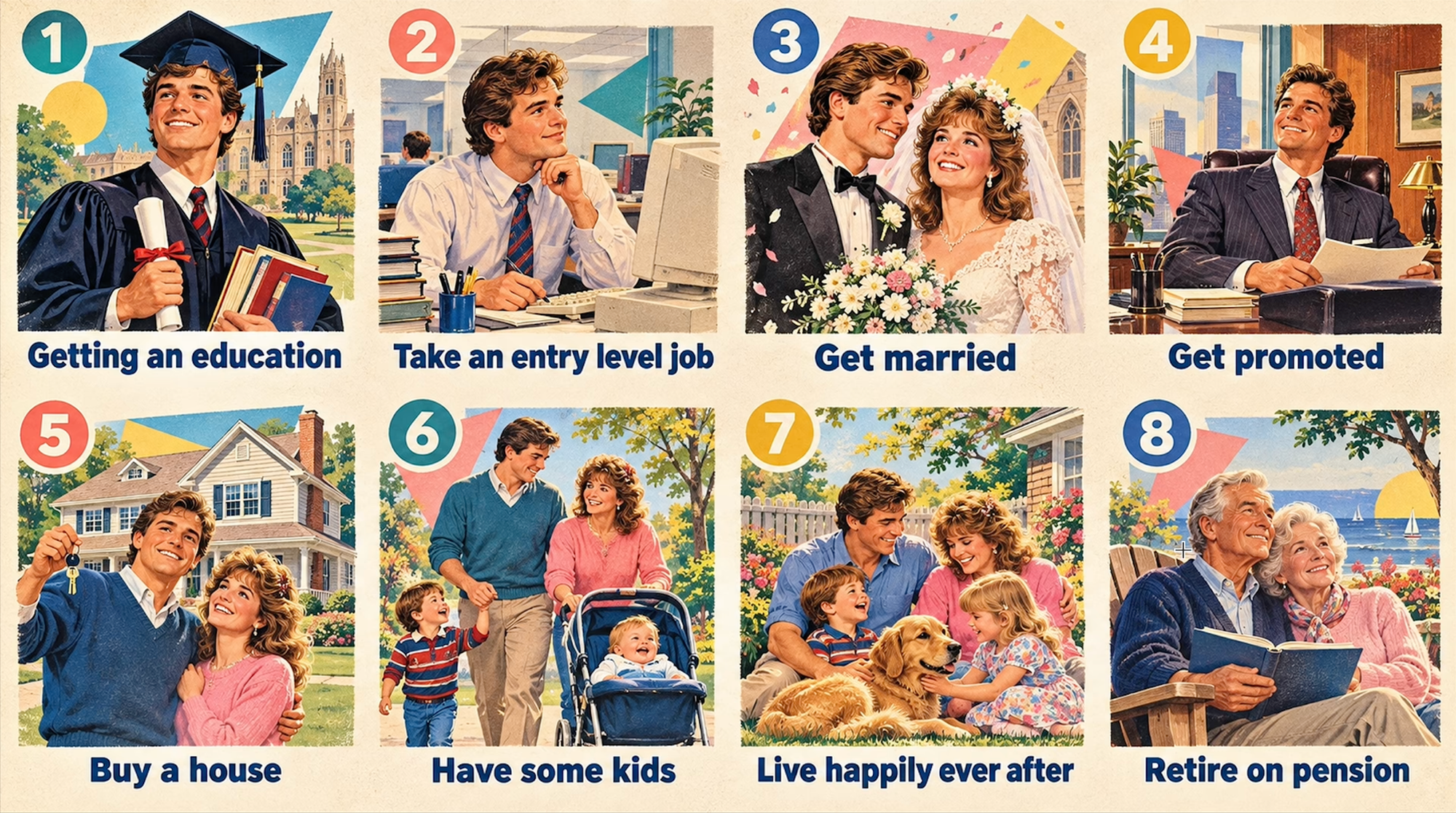
Thesis in one line: the old linear life plan (education → job → house → pension) is being killed by two compounding forces — unsustainable Western government finances and an exponential collapse in the cost of AI intelligence and initiative — so the only rational response is to own scarce assets.
1. Market review — "three things right", then frustration
- Bitcoin is back at its February price, which he calls "very frustrating".
- He credits three correct calls over the past 12 months:
- the early reversal "almost exactly a year ago" which began the long decline;
- the head-and-shoulders pattern between April and May ("very surprising to me at the time, but it did play out");
- the subsequent inverse head-and-shoulders build-up.
- The breakout through resistance did not hold; instead came "the biggest hack, the biggest heist in human history, not only in crypto".
- Gold: the parabola broke and the hoped-for $4,000 support "looks like it didn't" hold; a dedicated commodities video was promised later that week.
- Equities: previously strong, now "showing signs of some corrections". He repeats his earlier view that the whole period may still be a long consolidation, with a retest and bull market still hoped for.
- Framing metaphor: being "out here on the field, in the sun, in the rain, in the snow, practicing each day" so that when conditions align "we have a higher chance to shoot the big goal".
2. The dying model — politics and fiscal stress
- He argues the most obviously dying thing is the "old simple life plan" — education, entry-level job, marriage, promotion, house, children, pension — which "worked so well for previous generations".
- Evidence he cites (all as his own claims, not independently verified here):
- frustration among young people in Europe;
- New York City — "the home of Wall Street, the heart of capitalism" — electing "a rather socialist mayor", widely backed by young voters who feel capitalism "isn't working for them";
- France proposing to "tax the entire internet", Germany proposing to tax all AI, and Italy proposing a new exit tax;
- all driven by the Western debt situation.
- His own conclusion: "many legacy countries are in a very very very difficult situation", so people must "take on more own responsibility" rather than assume the state will provide. He contrasts this with an existing self-reliance mindset in much of Asia.
- He warns the change so far has been "rather subtle, especially the last 10 years", but "a huge change is coming" that will affect "professionals in my generation too"
3. The debt chart — budget balance vs debt-to-GDP
A scatter chart (from another account, annotated by him) plotting government budget balance (vertical) against government debt as % of GDP (horizontal), with real GDP growth added as a label:
| Country | His reading of the chart |
|---|---|
| UK | Budget deficit, already high debt, low growth |
| France | "Even worse" |
| Spain, Germany | "Almost no growth" |
| Poland | Better than it looks — ~3.8% growth and not high debt |
| Cyprus | Positive budget balance and "huge" real GDP growth |
| Denmark, Ireland | "Look good" |
| US | "Down here" — i.e. in the same problem cluster |
- His analogy: if these were companies, a CEO would call an all-employee meeting and announce "massive budget cuts, layoffs, the removal of the free cookies by the coffee machine". He links this to why "Elon Musk was so angry a year ago".
- The political trap he describes: countries inherited wealth, capital, infrastructure and great companies, so "people have gotten used to those cookies" and protest "for more benefits, not less", while leaders "do the will of the people".
- On the "just raise taxes / prices" reflex: he compares it to doubling prices to customers, after which "our best customers will go to a competitor". He offers credit to "anyone from any party" who tries to fix it.
4. Wealth concentration — perception vs measurement
- Chart comparison of 1984 vs 2024: the share owned by the richest 1% has risen in many countries, including the US and France, "less so in some of the other countries.
- Two qualifications he makes explicitly:
- the chart shows only relative distribution, not that the other 99% got worse off — "almost everyone have it better";
- "people are jealous creatures. Many prefer comparing themselves to others, not to themselves in the past."
- Timeframe matters: over 40 years there has been concentration, "but over 10 years, not really. And over 20 years, quite little". Hence his framing of it as largely a perception problem.
5. The core pattern — the collapsing price of intelligence (and initiative)
- Cost of "fixed AI capability" has fallen roughly 13x per year. His arithmetic:
| Period | Remaining price vs start | Work delivered per $1 |
|---|---|---|
| 2022 → 2026 (4 years) | ~0.0035% | ~28,000x |
| 2022 → 2030 (8 years, extrapolated) | ~0.000000123% | ~815 million x |
- Two-part argument:
- Intelligence alone was never the whole recipe — "taking initiative, agency, taking action" mattered too;
- AI agents are "a few years younger than the chat type AI" but maturing rapidly and "will bring the cost of initiative down to almost zero too".
- Therefore the historical formula intelligence + initiative = success "has only a few years left", and "our plan better not be to try to compete with this". He also plots it on a log scale, calling the linear model "already dying" — which he offers as an explanation for young people's frustration.
- Consequence for trading: this "dramatically changes the prospect of short-term like day trading" — a view he says he held when first recording his course eight years ago. But it does not change long-term technology trends or the concept of asset ownership.
6. Conclusion — build assets
What counts as an asset, in his definition: something AI cannot copy, and therefore scarce:
- equity in the leading technology companies;
- hard assets such as commodities;
- leading crypto assets;
- beachfront real estate;
- non-financial assets too, e.g. "trust networks with the right kind of people".
His stated plan: "build assets… learn to build assets… every day try to get a little better at it", because that is what protects him and his children from near-zero-cost intelligence and initiative. Recurring image: practising shots in the rain and snow while "99% of people are relying on that society will take care of them" or "still sleepwalking to their job".
Notable quotes
"Bitcoin first price right now is exactly the same as it was in February. Of course, that is very frustrating."
"If these were companies and you were the CEO, you'd call for an all employee meeting and announce massive budget cuts, layoffs, the removal of the free cookies by the coffee machine."
"People are jealous creatures. Many prefer comparing themselves to others, not to themselves in the past."
"I hate to break it to you, but AI has that too."
"Assets are what will protect me from this exponential intelligence at near zero cost."