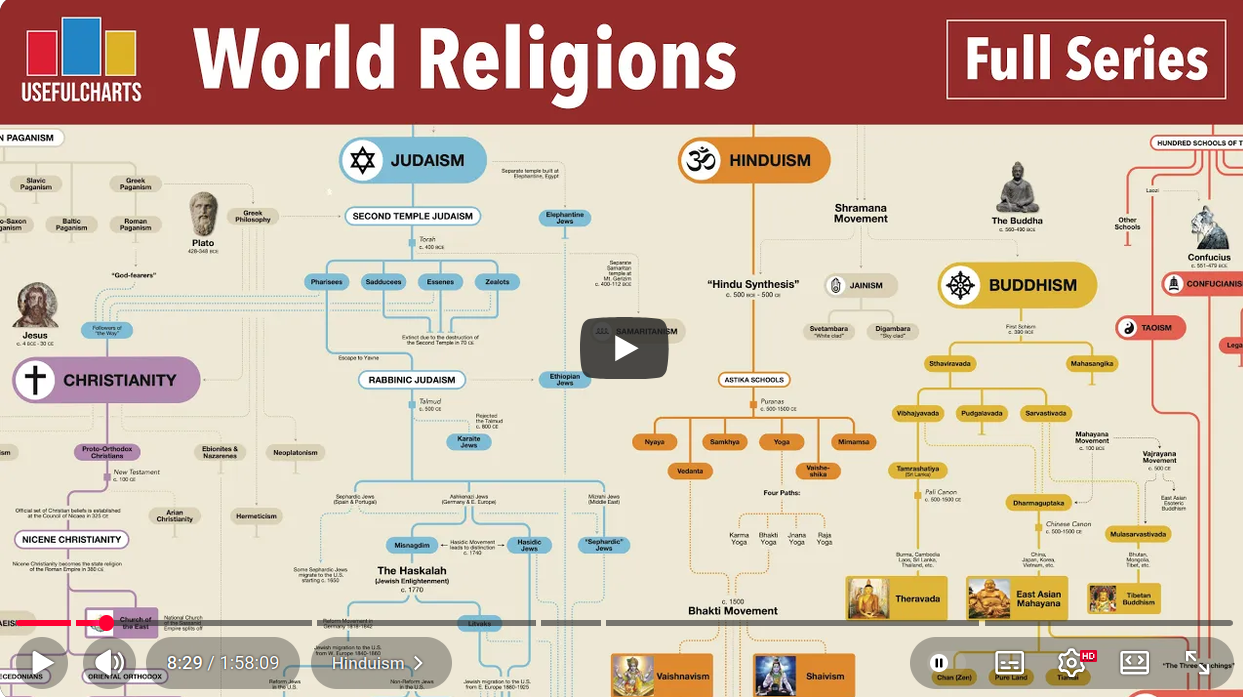
This is a video transcript (presented by Matt Baker) accompanying a World Religions Family Tree poster. It covers Hinduism, Buddhism, Chinese Syncretism, Judaism, and Islam, with an introductory section on prehistoric and ancient religions.
Click for the explainer on all world religions
Skip to time codes if you prefer: 00:05:27 - Hinduism, 00:28:48 - Buddhism, 00:50:31 - Chinese Syncretism 00:56:28 - Judaism, 01:33:29 - Islam
Christianity, being the largest group has its own explainer here.
Judaism is often counted as the fifth major world religion, but only has ~16 million followers. It is included because of its age and because it is the parent religion of Christianity and Islam.
By size alone, the fifth-largest would be Chinese Folk Religion (labelled here Chinese Syncretism) — "syncretism" meaning a mixture of different religious ideas.
Data source used: Pew Research Center.
A map shows the dominant religion in each country; the Big 4 and Chinese Syncretism stand out.
Prehistoric & Ancient Religions
Göbekli Tepe (in modern-day Turkey) is the oldest human-made structure on Earth and almost certainly served as a religious site. Used as an example of prehistoric religions generally — not claimed as the origin of all religions.
Four earliest historical-era religions highlighted:
Ancient Egyptian Polytheism
Ancient Mesopotamian Polytheism
Proto-Indo-European Polytheism
Indus Valley Civilization Religion (deliberately not labelled "polytheism" because the Indus script remains undeciphered)
These four influenced the two oldest religions still in existence: Judaism and Hinduism.
Ancient Egypt and Mesopotamia → Ancient Israelite Religion → Judaism
Indo-European and Indus Valley religions → Vedic Religion → Hinduism
A different Indo-European subset went to Persia (→ Zoroastrianism) and others to Europe (→ European Paganism → Greek Philosophy).
Persians and Greeks both ruled the Jews, so Zoroastrianism and Greek Philosophy influenced Judaism — meaning Judaism and Hinduism are remotely connected via the Proto-Indo-Europeans.
Chapter 2 — Hinduism
Terminology Notes
The word "denomination" is used loosely — it really only fits a Christian context; for non-Christian religions it means simply a branch or sub-group.
Hinduism itself may be better described as a cluster of religions grouped by their connection to India.
Hindus themselves call Hinduism a dharma (a cosmic order or set of divine laws), not a "religion."
Hinduism is one of the Dharmic religions, alongside Buddhism, Jainism, and Sikhism — all originating on the Indian subcontinent.
Hindu Conceptions of the Divine (not all Hindus are polytheists)
Type
Belief
Monotheist
All gods are aspects of one god
Henotheist
One Supreme God worshipped, lesser gods acknowledged
Pantheist
God and the universe are one and the same
Atheist
No belief in gods; approach Hinduism philosophically
The Three Main Gods (the Trimurti / "Hindu Trinity")
God
Role
Typical depiction
Brahma
Creator
Four heads; father of many gods; few temples dedicated to him today
Vishnu
Preserver
Multiple arms, blue complexion, holds a shell, sits on a multi-headed snake; male; incarnations (avatars) include Krishna and Rama
Shiva
Destroyer
Wild appearance, matted hair, animal-skin clothes, carries a trident; often worshipped as a lingam (a stone signifying formlessness, not a phallus)
Brahma (the god) must not be confused with Brahman (the concept of ultimate reality equated with the totality of the universe).
Shiva is not mentioned in the Rig Veda, but a very similar god named Rudra is, and is strongly associated with him.
Female Consorts
Consort
Pairs with
Depiction
Saraswati
Brahma
White lotus, stringed instrument, peacock
Lakshmi
Vishnu
Red lotus, elephants, coins pouring out
Parvati
Shiva
Also appears as Durga (warrior) or Kali (fearsome)
Ganesh (elephant-headed god) is the son of Shiva and Parvati.
Surya (sun god) and Chandra (moon god) — the latter explaining why India's moon missions are called Chandrayaan ("yaan" = vehicle).
Hindu Scriptures — Two Categories
Shruti ("that which is heard") — considered more authoritative; the four Vedas:
Veda
Note
Rigveda
Oldest
Yajurveda
Samaveda
Atharvaveda
Most recent
Each Veda has four layers:
Samhitas (hymns/prayers — oldest)
Aranyakas (instructions on rituals/ceremonies)
Brahmanas (commentaries on those instructions)
Upanishads (added last; more philosophical; represent Hinduism's transition from ritual system to a fully fledged religion)
Smriti ("that which is remembered") — a larger collection; three highlighted:
Mahabharata and Ramayana — epic poems (far longer than the Iliad). A small section of the Mahabharata is the Bhagavad Gita (often the only Hindu scripture Westerners know).
Puranas — stories and encyclopaedic information (genealogies of gods, royal dynasties).
Two Scenarios for the Development of Hinduism
Traditional Hindu view:
People of India are direct descendants of those living there 10,000 years ago; the religion has been essentially the same throughout.
History is cyclical, made of 4 ages, each worse than the last; after the fourth, the cycle repeats.
We are currently in the fourth age, which started around 3100 BCE (around the time of the Mahabharata War).
The Vedas are authorless, revealed to sages through intense meditation; near the end of the third age, the sage Vyasa compiled them and wrote the Mahabharata and Puranas.
Secular/academic view:
Hinduism evolved slowly with roots in at least three sources:
Indus Valley Civilization (one of the three oldest civilisations, alongside Egypt and Sumer) — its script is undeciphered, but an Indus Valley seal shows a figure sharing attributes with Shiva.
Local folk religions across the subcontinent (each with local gods; some villages still follow folk Hinduism combining Hindu practices with worship of a pre-Hindu local god).
Proto-Indo-European religion — the same source as the Greek, Roman, and Germanic pantheons. Examples: the sky father Dyeus (→ Zeus in Greece; Dyaus in the Rig Veda); dawn goddess Hausos (→ Eos in Greece; Ushas in the Rig Veda); horse twins (→ Hengist & Horsa in Anglo-Saxon legend; Ashvins in the Rig Veda).
The narrator explicitly rejects the "Aryan Invasion Theory" (which had racist overtones and claimed a sudden conquest causing the demise of the Indus Valley Civilization). The academic consensus is a slow migration of Indo-Europeans into India between 2000 and 1500 BCE, intermixing with local populations, supported by linguistic and DNA evidence.
Vedic → Brahminism → Hindu Synthesis
Vedic religion (named for producing the Vedas) was not the same as modern Hinduism: its main gods were Indra, Varuna, and Agni (not Vishnu and Shiva).
The claim that Hinduism is "the world's oldest religion, 4000+ years old" is not exactly true — its roots go back that far, but Hinduism as known today does not. The same applies to Judaism (roots ~3000 years ago; modern Judaism developed mostly between 600 BCE and 200 CE).
Brahminism: the priestly Brahmin caste was established; mainly practised in the Kingdom of Kuru.
The Shramana movement ("seekers") further east rejected Vedic authority and the Brahmins, promoting self-discipline and rejection of worldly pleasures. Buddhism and Jainism arose from it; it also influenced the "Hindu synthesis" (~500 BCE–500 CE), during which the Mahabharata, Ramayana, and Puranas were written.
Astika vs Nastika
Astika schools accept Vedic authority (orthodox; considered part of Hinduism).
Nastika schools reject the Vedas (heterodox; considered separate religions — e.g. Buddhism, Jainism).
The six Astika schools (philosophies, not denominations):
Nyaya
Vaisheshika
Samkhya
Yoga
Mimamsa
Vedanta
Yoga is not merely exercise (a Western misconception); it is a complete system of philosophy. It posits four paths to moksha (release from the cycle of rebirth):
Path
Involves
Karma Yoga
Working hard, doing good, serving others
Bhakti Yoga
Love and devotion to a particular god
Jnana Yoga
Pursuing knowledge
Raja Yoga
Meditation
These four paths are not denominations; Hindus of various denominations may follow one or more.
Four Main Hindu Denominations (grouped under Bhakti Yoga — divided by which god is worshipped)
Denomination
Supreme deity
% of Hindus
Notes
Vaishnavism
Vishnu (and avatars Rama, Krishna)
~70% (largest)
Vishnu grew in importance over time; the god Vasudeva merged with Krishna, then with Vishnu
Shaivism
Shiva
~25%
Mostly South India; Shiva worshipped as lingam
Shaktism
Shakti (= Parvati/Durga/Kali)
~5% (combined with Smartism)
Supreme deity as female goddess
Smartism
Five gods worshipped equally: Ganesh, Shiva, Shakti, Vishnu, Surya
~5% (combined with Shaktism)
Name derived from Smriti
The merging of gods is common in religious history: in Canaan, El and YHWH were originally separate but merged — explaining why the Bible sometimes calls God "El/Elohim" and sometimes "YHWH."
Neo-Hindu Movements (Western, since mid-20th century)
Mostly founded by individual, often controversial, gurus. Two highlighted:
Bhaktivedanta Swami Prabhupada — founded the International Society for Krishna Consciousness (ISKCON / "Hare Krishnas"); traces roots to Gaudiya Vaishnavism (~1500, focuses on Krishna as Supreme). Prabhupada was controversial (racist, anti-Semitic, sexist, classist comments); ISKCON later admitted physical and sexual abuse within the organisation and has taken steps to rebuild.
Maharishi Mahesh Yogi — known for association with the Beatles; founder of the Transcendental Meditation Movement (marketed as non-religious but rooted in Hindu meditation techniques).
Hinduism overall: ~1.1 billion followers, world's third-largest religion, mostly limited to South Asia (and diaspora communities).
Vedic Religion developed in India ~1500 BCE after Indo-Europeans migrated in.
By ~500 BCE it had become Brahminism, with a caste system:
Caste
Role
Brahmins
Priests
Kshatriya
Secular rulers and warriors
Vaishya
Farmers and merchants
Shudra
Labourers and servants
Dissent gave rise to the Shramana movement, popular along the Eastern Gangetic Plain.
~500 BCE, northern India was divided into sixteen independent states (Mahajanapadas). Brahminism strongest in the Kingdom of Kuru; Shramana movement took hold in states like Kosala, Vriji, and Magadha.
This led to the Hindu Synthesis and the Astika/Nastika division.
Other Nastika schools besides Buddhism and Jainism: the atheist Charvaka, the agnostic Ajñana, and the fatalistic Ajivika.
The Buddha
Unlike Hinduism, Buddhism has a founder: Siddhartha Gautama, a prince in the Kingdom of Kosala, belonging to the Shakya ethnic group (in modern Nepal) — hence his earliest title Shakyamuni ("Sage of the Shakyas").
At 29, he left luxury to become a Shramana; practised asceticism; at 35, achieved enlightenment under a tree, becoming "the Buddha" ("the Enlightened One").
He preached the Middle Way (between overindulgence and self-denial) and laid foundations summarised by the Four Noble Truths and the Eightfold Path.
He built a community of followers called the Sangha. The Triple Gem / Three Jewels = the Buddha, the Dharma, and the Sangha.
Died at 80, around 480 BCE.
Buddhist Councils & Early Schisms
Council
Timing
Key outcome
First
~480 BCE (after Buddha's death)
500 followers; disciple Ananda recited the teachings (sutras); Upali recited community rules (vinaya)
Second
~100 years later
Disagreements over rules → first Buddhist schism: majority Mahasangika ("Great Sangha") vs minority Sthaviravada ("School of the Elders")
All modern branches of Buddhism descend from the Sthaviravada (debate exists over Mahasangika's influence on Mahayana).
In ancient times, at least 18 separate schools existed. Around Ashoka's time (the emperor who first united most of India), the three main were Vibhajyavada, Sarvastivada, and Pudgalavada.
Ashoka converted to Buddhism and sent missionaries; his son Mahinda brought Buddhism to Sri Lanka.
Theravada Buddhism
From Sri Lanka, Buddhism spread to Burma, Thailand, Laos, Cambodia — all very similar, now called Theravada (the Pali version of the Sanskrit Sthaviravada, meaning "School of the Elders"). Sees itself as original Buddhism; more strict and earthly-focused.
In Sri Lanka, the school founded by Mahinda was the Tamrashatiya (a branch of Vibhajyavada).
The Pali Canon (oldest surviving complete Buddhist scriptures)
A full set of scriptures = Tipitaka ("three baskets"):
Pitaka
Contents
Vinaya Pitaka
Community rules (for Bhikkhus / male monks and Bikkhunis / female monks/nuns); plus some early Buddhist history
Sutta Pitaka
Buddha's teachings; divided into five nikayas (volumes), further broken into smaller books; notable: the Dhammapada (5th nikaya; best-known Buddhist scripture, good starting point)
Abhidhamma
Analysis of teachings; Pali Canon version has seven parts
Pali is closely related to but not the same as Sanskrit.
Mahayana Buddhism
Two main types of Buddhism today: Theravada and Mahayana (Tibetan Buddhism is relatively small).
Mahayana origins unclear — possibly from the extinct Mahasangika, possibly laypeople. Not a separate school but a movement across schools.
Common factor: an additional set of Mahayana sutras, said to have been hidden after the Buddha's death and revealed later when the time was right.
The Dharmaguptaka school (centred in Gandhara, modern Pakistan/Afghanistan) was an early adopter; its old Buddha statues were destroyed by the Taliban in 2001. It spread to China, Korea, Japan, Vietnam; all East Asian Mahayana monks follow Dharmaguptaka community rules today.
The Chinese Canon (main alternative to the Pali Canon)
Also a tripitaka, but:
Buddha's teachings called agamas (only four, roughly matching the first four Pali nikayas).
Vinaya and Abhidharma sections differ (Dharmaguptaka rules + rules from extinct schools).
Main difference: includes additional sections, most notably the Mahayana Sutras (key ones: Lotus Sutra, Perfection of Wisdom Sutra, Flower Garland Sutra, Nirvana Sutra), plus the Jataka (Buddha's birth story) and a section on tantras (esoteric/secret practices).
Written in Classical Chinese (Japanese version includes some Japanese parts).
The Pali Canon is better described as the oldest complete version — some parts of the Chinese Canon have older corresponding Sanskrit versions, but the complete Chinese canon is not available in Sanskrit.
Theravada vs Mahayana — Paths to Enlightenment
Both aim for enlightenment, freeing one from the cycle of birth, death, and rebirth (also the goal in Hinduism).
Theravada — three paths:
Student path (most common) → become an arhat (via strict discipline); no longer reborn.
Solitary Buddha — achieves enlightenment alone but cannot teach it.
Full Buddha path — achieves enlightenment alone and can teach others (the path of Siddhartha Gautama = THE Buddha).
The Pali Canon mentions 27 named Buddhas before THE Buddha (three most recent: Kakusandha, Konagamana, Kassapa) and a future Buddha, Maitreya.
A Bodhisattva = someone on the path to full Buddhahood. In Theravada, Bodhisattvas are rare (Maitreya is the only current one); most take the Arhat path.
Mahayana differences:
Views the first two paths as inferior; calls Theravada "Hinayana" ("the lesser path"), while Mahayana means "the greater path."
The Bodhisattva path (Full Buddha path) is open to everyone; Bodhisattvas are compassionate beings who delay enlightenment to help others; many reside in higher realms and are prayed to.
Example: Budai (the "Laughing/Fat Buddha"), a monk ~1000 years ago — a Bodhisattva, not THE Buddha. Some think he is Maitreya.
Are there gods in Buddhism? Depends on definition. Buddhism is often called atheistic, but Mahayana Bodhisattvas resemble spiritual beings; in Theravada, standing before a Buddha statue with hands together is showing respect / aiding meditation, not worshipping a god.
Three Popular East Asian Mahayana Sub-branches
School
Known as (Japan/Korea)
Focus
Chan
Zen (Japan)
Meditation; popular in the West
Pure Land
—
Rebirth in a "purified land"; most popular is that of Amitabha
Tiantai
Tendai (Japan) / Cheontae (Korea)
Focuses on the Lotus Sutra; all paths lead to the one Bodhisattva path
Tibetan Buddhism (Vajrayana)
Vajrayana was a movement (not a separate school) that split off from early Mahayana and impacted several schools.
The Mula-sarvastivada school (likely a branch of Sarvastivada) took on Vajrayana ideas and spread to Tibet and Bhutan.
Distinctive: more esoteric practices — chanting, incantations, mandalas (geometric patterns to induce trances).
The Dalai Lama is leader of just one of four Tibetan Buddhist sects: the Gelug or "Yellow Hat" school (the largest). He is the 14th Dalai Lama, believed to be the reincarnation of Gedun Drupa (died 1474); all Dalai Lamas are incarnations of the Bodhisattva Avalokitesvara.
Jainism (briefly)
Also from the Shramana movement; founded by Mahavira (older contemporary of the Buddha; born in Vriji; the Buddha was born in Kosala).
Key feature: non-violence; most Jains are vegetarians.
Much smaller than Buddhism today; two main branches:
Branch
Meaning
Distinction
Svetambara
"White clad"
Monks wear white robes (and face masks, to avoid contaminating sacred items)
Digambara
"Sky clad"
Male monks wear no clothes (minimal earthly possessions)
Chapter 4 — Chinese Syncretism
Religion in China is syncretic — people mix and match from multiple traditions.
The "Three Teachings": Mahayana Buddhism, Taoism, and Confucianism.
Chinese Polytheism (earliest form)
Earliest Chinese writing: oracle bone script (Shang dynasty). The symbol "Shang-di" means "highest god," later associated with the Jade Emperor; in other contexts, manifests as five deities (each linked to a colour, element, direction, and planet).
Many other gods (e.g. the dragon god controlling rain; Xiwangmu, the Queen Mother of the West, associated with death and able to bestow immortality).
Ancestor veneration became as important as (or more than) deity worship.
Immortals — former humans, not quite gods, who live on after death with great powers. Self-cultivation in this life became increasingly important.
Hundred Schools of Thought (500s BCE)
An explosion of new ideas; most schools went extinct, but two survived:
Taoism — the more mystical/spiritual; incorporates all gods and immortals; emphasises living in harmony with the Tao ("way"/"path" or the universe's ultimate reality), associated with yin and yang. Traditional founder Laozi (legendary; said to be Confucius's elder and influence).
Confucianism — more focused on the physical world, practical matters (good government, social harmony at family and national level); often described as more philosophy than religion. Named after Confucius (anglicised form of Kong Fuzi, "Master Kong"); almost certainly historical.
Modern Trends in Chinese Religion
Chinese salvationist religions — popular early 20th century, now mostly in Taiwan. Example: Yiguandao (roots in imperial times; took off after 1912 when China became a republic; led by Zhang Tianran to ~12 million members; stamped out under communism, revived in Taiwan in the 1980s). Described as a simplified Chinese Syncretism packaged like Mormonism (revered leader, revelation from God, emphasis on salvation and conversion). Another example: Weixinism, founded by Hun Yuan.
Falun Gong — founded by Li Hongzhi around the same time; not classified as a salvationist religion but shares similarities; more focused on Qigong exercises; popular in the Chinese expat community in the West; known for being very conservative and protesting against China.
Chapter 5 — Judaism
Key Differences Between Judaism and Christianity
A common frustration: Christians assume they know Judaism from reading the Old Testament through a Christian lens, assuming Judaism is Christianity "without Jesus." This is not how Judaism works.
Christianity
Judaism
Primarily concerned with belief ("What does this church believe?"; creeds like the Nicene Creed; John 3:16)
Primarily concerned with practice ("What should a person do?")
Central question of salvation ("What must one do/believe to be saved?")
No concept of Original Sin; little focus on afterlife details; Law is followed because God commanded it and/or because it serves a purpose in the here and now, not to earn future reward/avoid punishment
Belief comes first, then a changed life
Doing/practice is emphasised more than belief
The narrator (a convert) was never asked to agree to a list of beliefs during his year-long conversion; he was taught Jewish practices, traditions, history, and language.
Analogy: traffic laws are obeyed not just to avoid tickets but to keep people safe (e.g. not hitting a child in a school zone). Likewise, resting on Shabbat (Saturday) is done because of the benefit, not fear of punishment.
Quoted principle from the early Pharisee Antigonus of Sokho: "Be not like servants who serve their master for the sake of reward. Rather, be like servants who do not serve their master for the sake of reward, and let the awe of Heaven be upon you."
Some Jewish beliefs do exist: for some, the only creed is the Shema ("Hear O Israel. The Lord is our God, the Lord is one"); for the Orthodox, the Thirteen Principles of Faith by Maimonides.
Roots of Judaism
Roots in Ancient Israelite religion, practised by the Kingdoms of Israel and Judah, located between Egypt and Mesopotamia.
Two explanations: divine revelation (Moses receiving the Torah) vs. scholarly consensus that Israelites started as a subset of Canaanites and slowly moved from polytheism to monotheism.
Israel fell to the Assyrians; Judah fell to the Babylonians; after exile in Babylon, Jews returned and rebuilt the temple.
Second Temple Judaism: 537 BCE – 70 CE. Influenced by Zoroastrianism (Persian religion) and Hellenism (Greek religion). By this point, Judaism was definitively monotheistic — its defining feature.
Four Major Sects of Second Temple Judaism (+ early Christians)
Sect
Description
Pharisees
Represented the everyday people
Essenes
A mystical group
Zealots
Wanted to fight the Romans
Sadducees
Elites who ran the temple
Early Christians
A fifth group; quickly became a separate, mostly Gentile religion
Jewish-Christian groups that maintained Jewish traditions (e.g. Ebionites, Nazarenes) eventually went extinct but may have influenced Islam.
The Essenes, Zealots, and Sadducees all went extinct when the Romans destroyed the Temple in 70 CE.
Only the Pharisees survived — they are the spiritual ancestors of Jews today. After Jerusalem's destruction, they set up a school in Yavne (Jamnia in Christian sources), helping Judaism evolve from a temple-based religion to one based on communal prayer and Torah study.
The scholars became known as rabbis; Judaism today is more accurately called Rabbinic Judaism.
The Talmud
Two components:
Mishnah (written first) — based on the Oral Torah (clarifications given to Moses alongside the Written Torah, passed down orally). Modern critical scholarship says it likely does not go back to Moses but at least to the Second Temple period (figures like Hillel and Shammai, just before Jesus).
Gemara (written later) — commentary on the Mishnah.
The Talmud is more like a collection of case law (opinions, and opinions about opinions) than a list of clear-cut rules; anti-Semitic claims typically take it out of context.
Groups Outside/Alongside Mainstream Rabbinic Judaism
Karaite Jews — reject the Talmud; some claim descent from the Sadducees, but more likely broke away from Rabbinic Judaism around 800 CE.
Beta Israel (Ethiopian Jews) — may go back to Second Temple times; possibly maintained early contact with rabbis before contact was severed; "rediscovered" and integrated into mainstream Judaism in modern times — a unique stream within Rabbinic Judaism.
Samaritans — definitely a separate group; claim descent from the Northern Ten Tribes. Historically complex (involves Assyrian conquest, intermarriage, a separate temple at Mount Gerizim). Today: only ~850 people.
Sephardi, Ashkenazi, and Mizrahi — NOT Denominations
These are regional subcultures, not denominations or theological differences; analogous to Catholics using Latin vs Syriac rites (different liturgy, same theology).
Sephardic Jews — from Spain/Portugal (S'pharad = Hebrew for Spain); ruled by Muslims for centuries, generally treated well; expelled after the Reconquista; many went to the Middle East (welcomed by the Ottomans), North Africa, the Low Countries, or the New World.
Ashkenazi Jews — name from Ashkenaz (old Jewish name for Germany). Recent DNA studies: originated in Southern Italy, settled in Germany ~800; numbers dwindled to ~350 (a genetic bottleneck), then mostly intermarried among themselves, creating a distinct ethnic group with clear DNA markers. Much of their DNA traces back to the Middle East, especially along the male line. Later pushed into Eastern Europe.
Mizrahi Jews — a catch-all term for Jews who never left the Middle East; assimilated many Sephardic customs; often lumped with Sephardi today.
Minhag = "customs"; Sephardi and Ashkenazi Jews may have different minhag but share the same religion. Each relies on the other's philosophical works (e.g. Maimonides was Sephardi but important to Ashkenazis; Rashi was Ashkenazi but authoritative for Sephardis).
Shulchan Aruch (1565) by Sephardic rabbi Joseph Karo, with notes by Ashkenazi rabbi Moses Isserles — the authoritative text for Jewish law; used by both, but on customs, Ashkenazis follow Isserles and Sephardis follow Karo.
Modern Branches of Judaism (from ~1740 onwards)
From 70 CE to ~1740 CE, there was essentially one Judaism (with regional customs), partly because Jews were a small, persecuted minority and partly because Judaism has no central leadership (congregational governance, like Baptists).
The sole difference between the three main branches is their appro to Halakha (Jewish law):
Branch
Approach to Halakha
Notes
Orthodox
Binding and unchanging
Followed carefully as for 2000+ years; done because God says so, not for salvation
Conservative (Masorti outside North America)
Binding but not unchanging — should evolve with society
E.g. permits driving to synagogue on Shabbat; allows women rabbis; supports LGBT rights
Reform
Neither binding nor unchanging — each Jew decides
E.g. might adopt a pescatarian diet for ethical/climate reasons instead of traditional kosher rules; emphasise Tikkun Olam ("repairing the world"); prioritise ethical mitzvot over ritual mitzvot
Pikuach Nefesh — followed by every branch: any law can be broken to protect life/health (e.g. even the most Orthodox Jew will drive on Shabbat for a medical emergency). Three exceptions: cannot murder, worship idols, or commit a sexual sin.
Orthodox Subsets
Haredi ("Ultra-Orthodox" — usually considered offensive) — the most visibly Jewish (big black hats, long side curls). Subdivided into:
Hasidic — a very mystical version (relies heavily on Kabbalah, going back to Isaac Luria in the 1500s and Moses de León in the 1200s); founded by the Baal Shem Tov in Ukraine in the 1700s. Each Hasidic group centres on a rabbinical dynasty traced to a specific Eastern European village. E.g. Chabad (originally from Lyubavichi, Russia → followers called Lubavitchers); 20th-century leader Mendel Schneerson (1902–1994), descendant of founder Shneur Zalman. Some Sephardis have also adopted Hasidism.
Non-Hasidic — known as Mitnagdim ("opponents"), later Litvaks (many based in Lithuania).
Modern Orthodox — non-Haredi Orthodox Jews, more integrated into wider society.
The Haskalah (Jewish Enlightenment)
Around 1770 (mostly among the Mitnagdim); similar to the European Age of Enlightenment a century earlier. Judaism re-examined via modern critical scholarship. Accompanied by Jewish emancipation across Europe (equal legal rights). Some Jews became secular; others (especially in Germany) sought to reform Judaism using science and textual criticism.
American Jewish Denominations
In the US (and similar countries like Canada and the UK), Judaism divides into denominations; elsewhere less so.
1840–1860: German Jews migrated to the US; before this, most American Jews were Sephardic. Soon most congregations were Ashkenazi and leaning Reform.
1873: Union of American Hebrew Congregations established (later renamed Union for Reform Judaism).
1875: Hebrew Union College founded (main Reform rabbinical school).
1886: Conservative-leaning rabbis broke away, established the Jewish Theological Seminary.
1880–1925: Eastern European Jews migrated; more conservative, became the Orthodox.
1898: Orthodox Union established (for Modern Orthodox) — its kosher certification symbol is widely seen on food packaging.
1913: United Synagogue of America established (Conservative; later renamed United Synagogue of Conservative Judaism).
Agudah — another Orthodox organisation, mostly Haredi congregations (Hasidic and non-Hasidic); Chabad is notably not a member.
Among US synagogue-attenders: ~50% Reform, ~30% Conservative, ~20% Orthodox.
Additional Branches
Reconstructionist (Reconstructing) Judaism — founded by Mordecai Kaplan in the 1950s; a breakaway from Conservative Judaism; does not see Halakha as binding (like Reform) but values preserving traditions and a distinct Jewish identity ("conservative on the outside, liberal on the inside").
Renewal Judaism — rooted in the 1960s–70s counterculture; very liberal but incorporates mystical elements from Hasidism; followers sometimes nicknamed "hippie Jews."
Humanist Jews — do not even believe in God but gather to celebrate holidays and rites of passage.
Messianic Jews — really Christians; covered in the Christian denominations series (Episode 8).
Denominational lines can be blurry, especially where few Jews live; the narrator (in Canada) converted through a Reform synagogue, had an Orthodox rabbi perform his Hatafat Dam Brit, immersed in an Orthodox mikveh, and attends a Renewal synagogue; describes himself as a "progressive Jew" (everything other than Orthodox — the dominant type in North America).
UK
Two major Reform denominations: Liberal Judaism and the Movement for Reform Judaism; in April 2023 they announced intention to merge.
Has a Chief Rabbi for Orthodox Jews (participated in the coronation of King Charles III).
Israel
Jewish population has now surpassed that of the US. The Reform-Conservative-Orthodox trichotomy is far less important. Jews are usually classified into four categories (not denominations):
Category
Meaning
% of Israeli Jews
Hiloni
Secular
~50%
Masorti
Traditional (partially observant)
~25%
Dati
Fully observant
~25% (combined with Haredi)
Haredi
Most strictly observant
~25% (combined with Dati)
Religious matters fall under two Chief Rabbis (one Ashkenazi, one Sephardi) — a system used in most countries; some (e.g. France) have one Chief Rabbi, others (e.g. Argentina) have two.
Zionism is political, not religious; individual Jews have differing views; being Jewish does not mean supporting everything the State of Israel does.
Chapter 6 — Islam
Origins — Traditional vs Academic
Traditional account: Islam began with Adam, with subsequent prophets (Noah, Moses, Jesus) preaching Islam in different forms; it took its current shape with Prophet Muhammad receiving the first revelation of the Qur'an ~610 CE.
Academic account: Islam emerged from mixing of ancient Arabic pagan traditions and Jewish Christians (specifically Ebionites and Nazarenes, who upheld Jewish Law and believed Jesus was the Messiah, possibly fleeing to Arabia to avoid persecution). Islamic tradition mentions Hanifs who followed the true monotheism of Abraham — possibly these Jewish Christians.
The Qur'an & the Hijrah
From 610 CE to Muhammad's death (~632 CE), revelations from Allah (Arabic for God) were compiled into the Qur'an ("Recitation") — the highest authority for all Muslims.
622 CE: ~11–12 years after the first revelation, the Prophet went into exile from Mecca and formed a community in Yathrib (later Madinah). This emigration is the Hijrah — marks the beginning of the Islamic lunar calendar and a turning point in the Qur'an.
The Qur'an has 114 chapters (Surahs):
Meccan chapters: focus on theology — Tawhid (monotheism/oneness of God), the Day of Judgement ("the Hour"), Heaven and Hell.
Madinan chapters (after Hijrah): focus on jurisprudence/law — because the Prophet was now also a political leader (arbitrating disputes, war, diplomacy).
Aqidah vs Fiqh
Concept
Deals with
Aqidah
Theological nature of Islam (e.g. free will vs predestination)
Fiqh
Judicial/legal nature (e.g. punishments for sins)
They overlap; Aqidah guides Fiqh but not always.
The Sunni–Shia Division
After Muhammad's death (632), the first disagreement was who would lead the community.
Some elected Abu Bakr (the Prophet's close friend) as the first Caliph (Khalifa) = successor/deputy, titled Amir al-Muminin (Leader of the Believers).
Another party wanted Ali ibn Abi Talib (the Prophet's cousin and son-in-law).
These are better called Proto-Sunnis and Proto-Shias — the two sects didn't crystallise until the 11th century. Initially a simple leadership dispute; became more complex over time.
The caliphs rapidly expanded the empire: within decades, ruling everything between Tunisia and India, defeating the Byzantine and Sassanid Empires.
For matters not addressed in the Qur'an, Muslims looked to the Sunnah (the Prophet's examples and sayings). Still many gaps remained → further division.
Sunnis (~90% of Muslims; ~9% Shia; <1% other):
Name from the Sunnah. Believe the Prophet's examples, plus the opinions of learned scholars (Ulema — broadly analogous to rabbis; Islamic jurisprudence has many parallels with Jewish law), can guide believers. Among the Ulema, distinguished authorities are called Imams — respectable but not infallible, merely educated humans.
Shias:
Believe their Imams are infallible, have divine guidance, and are the sole authority on interpreting the Qur'an and tradition. The Imam must be a descendant of the Prophet through his daughter Fatima and her husband Ali ibn Abi Talib.
Ali = 1st Imam; his sons al-Hasan (2nd) and al-Husayn (3rd).
The role of Imams is the biggest distinction between Sunnis and Shias today. Each has its own chains of Imams and developed its own interpretation of Islamic law (Shariah).
The division was historically a spectrum, not a binary.
Sunni Schools of Jurisprudence (Madhhab)
School
Region
Notes
Hanafi
India, Pakistan, Turkey, parts of Middle East
Largest
Maliki
Africa; formerly Muslim Spain
Shafi'i
Middle East
Hanbali
Middle East; dominant in Saudi Arabia
Zahiri (extinct)
Muslim Spain, NW Africa
Reviving with Islamic revivalist movements
Sunni Schools of Theology
School
Position
Athari
Traditionalists; stick to Qur'an and Sunnah
Mu'tazilites
Follow reason and rational thinking
Ash'ari
In between
Maturidi
In between
In practice the divisions were not neat — e.g. the Mu'tazilites, despite claiming rationalism/progressivism, were behind one of the biggest inquisitions in Islamic history.
Hanbalis follow Athari theology; Hanafis follow Maturidi. Hanbalis stick to literal meaning; Hanafis (centrist) use some rational thinking, analogy, and consensus.
Most Muslims identify more with their Madhhab than their school of theology. In Muslim-majority countries, people attend mosques of their own Madhhab (prayer methods differ); in Western countries, people attend whatever mosque is available within their sect.
The Mihna (Inquisition)
During the reign of Abbasid Caliph al-Ma'mun. Key question: was the Qur'an created at the time of revelation, or had it always existed?
If always existed → true for all time, interpretations cannot change.
If created → applied only to that time, meaning can change with the times.
Al-Ma'mun believed he, as Imam, had the power to define Islamic theology/jurisprudence (rather than the Ulema). The Mu'tazilites supported him; the main opponent was Imam Ahmad ibn Hanbal (founder of the Hanbali school). Refusal to support the "created Qur'an" doctrine led to imprisonment, torture, seizure of property.
When the inquisition failed, the Mu'tazilites declined and died out (though neo-Mu'tazilites now try to revive them). Crucially, Sunni Caliphs never again tried to define theology/jurisprudence directly — which is why Sunni Islam has no Head of Faith like the Pope.
Revivalist Movements (18th century onwards)
As Ottoman and Mughal empires declined and Europeans took over, scholars concluded Muslims had drifted from true Islam.
Shah Wali Ullah Dehlawi (India, early–mid 18th century) — advocated learning from the Qur'an and Sunnah directly rather than following medieval Imams; he and his son translated the Qur'an into Persian and Urdu respectively.
Muhammad ibn Abd al-Wahhab (late 18th century, Arabia) — similar disassociation with medieval schools; his doctrine Wahhabism became dominant in Saudi Arabia; more fundamentalist.
Wahhabis are often grouped with the Ahl-e-Hadith (born in India); both are Ghair-Muqalid (claim not to follow any medieval school, but in practice lean Hanbali). They call themselves Salafi (after the Salaf/"Elders" = the first generation of Muslims). Wahhabis are more fundamentalist; Ahl-e-Hadith more moderate.
Deobandis — followed Shah Wali Ullah but adhered to the Hanafi Madhhab; came from his followers alongside the Ahl-e-Hadith.
Barelvis — Hanafis mixed with a lot of Sufism; alongside Deobandis, form the majority of Muslims in India and Pakistan. The Ahl-e-Hadith, Wahhabis, and Deobandis dislike Sufism; Barelvis embrace it.
Sufism — a mystical form of Islam with many orders/brotherhoods; some strictly Shia, some strictly Sunni, others in between (not covered in detail here).
Shia Sub-sects
Sub-sect
Key point
Zaydis
Believe in the Imamate of Zayd ibn Ali; Imams must also fight for the Caliphate; mostly in Yemen
Isma'ilis
Follow Imam Ja'far as-Sadiq; were very active in 9th–10th centuries; formed their own caliphate in Egypt in 969 (Fatimids)
Twelvers (Imamiyyas)
~85% of Shias today; became dominant in Iran during the Safavid Empire
Seveners — now extinct.
All three Ja'fari sub-sects were divided over the succession to Imam Ja'far as-Sadiq.
Interesting point: the founder of the Hanafi school (biggest Sunni school) was a student of Imam Ja'far as-Sadiq (founder of the biggest Shia school) — illustrating how flexible the split was early on.
Shias accept the Sunnah but only parts narrated by Companions who sided with Ali, interpreted by the Imams.
Qarmatians (Isma'ili offshoot, now extinct) — universally reviled for sacking Mecca in 930 and stealing the sacred black rock.
Druze — came from the Fatimids; not considered Muslim; a major religious group in Syria; theology is secretive; believe in reincarnation of the soul.
Twelver Internal Divisions & Offshoots
Usuli (majority) vs Akhbari — Akhbaris use only traditional teachings for judgments; Usulis believe reasoning should also be used.
Alawites — a Twelver branch; primarily in Syria and Turkey; not considered Muslim by most other sects. Often confused with the Alevis (more likely a Sufi order than a Shia sub-group; also Islamhood-disputed).
Babist and Baha'i faiths — came from Twelver Shias; not Muslims but retain Shia elements. Baha'u'llah declared himself the Mahdi (a messianic figure expected by both Shias and Sunnis at the end of time). Some Baha'is believe Christ returned in 1844 (paralleling the Great Disappointment of the Millerites). Notable member: Rainn Wilson (Dwight Schrute on The Office US).
The Third Major Sect — Kharijites (Muhakkima)
Origin: the First Fitna (civil war) between Ali ibn Abi Talib (Caliph) and Mu'awiyah ibn Abu Sufyan (governor of Syria who refused to recognise Ali). At the Battle of Siffin, so much bloodshed occurred that both sides agreed to arbitrate.
Some on Ali's side (the Shia tul-Ali — origin of the name "Shia") rejected arbitration as against the Law of God, left Ali's camp, and formed a third side: the Kharijites ("those who left") / Muhakkima.
They followed a very rigid, extreme interpretation ("our-way-or-death") — the first actual division in the community.
The original Kharijites are now extinct; a more moderate version, the Ibadis, survives — the majority in Oman. Ibadis prefer not to be called Kharijites and claim no connection, so both are shown branching from the Muhakkima.
Groups Whose Muslimhood Is Disputed
Ahmadis — founded by Mirza Ghulam Ahmad in India. Almost all other Muslims accuse them of elevating Ghulam Ahmad to the level of a prophet; since Islam holds Muhammad as the last prophet, this goes against a fundamental belief. No other group considers them Muslims.
Nation of Islam — founded by Wallace Fard Muhammad; popular in the US, especially among Black Americans. Members claim Fard Muhammad was the Mahdi (and perhaps divine). Notable members: Elijah Muhammad (succeeded Fard) and Malcolm X (left in 1964 for mainstream Islam). Elijah Muhammad's son Wallace moved it toward mainstream/Sunni Islam and dissolved the old Nation, but Louis Farrakhan revived it, so it still exists today.
Summary of Overall Structure
The transcript traces a grand narrative from prehistoric religion (Göbekli Tepe) through four ancient religions that seeded the two oldest surviving religions (Judaism and Hinduism), connected via the Proto-Indo-Europeans. It then works through each major tradition in turn — Hinduism (gods, scriptures, denominations, neo-Hindu movements), Buddhism (councils, canons, Theravada/Mahayana/Vajrayana, plus Jainism), Chinese Syncretism (the Three Teachings and modern movements), Judaism (practice over belief, Halakha approaches, denominations and subcultures), and Islam (Aqidah/Fiqh, Sunni/Shia/Kharijite, schools, revivalism, disputed groups). A recurring theme is that denominational categories do not map neatly onto non-Christian religions, that religions change over time (making dating imprecise), and that the narrator presents both traditional and academic/secular accounts of origins.
 Roger Price